09Healthcare· UX Team
Doctor AI will see you now
// A story from 2051
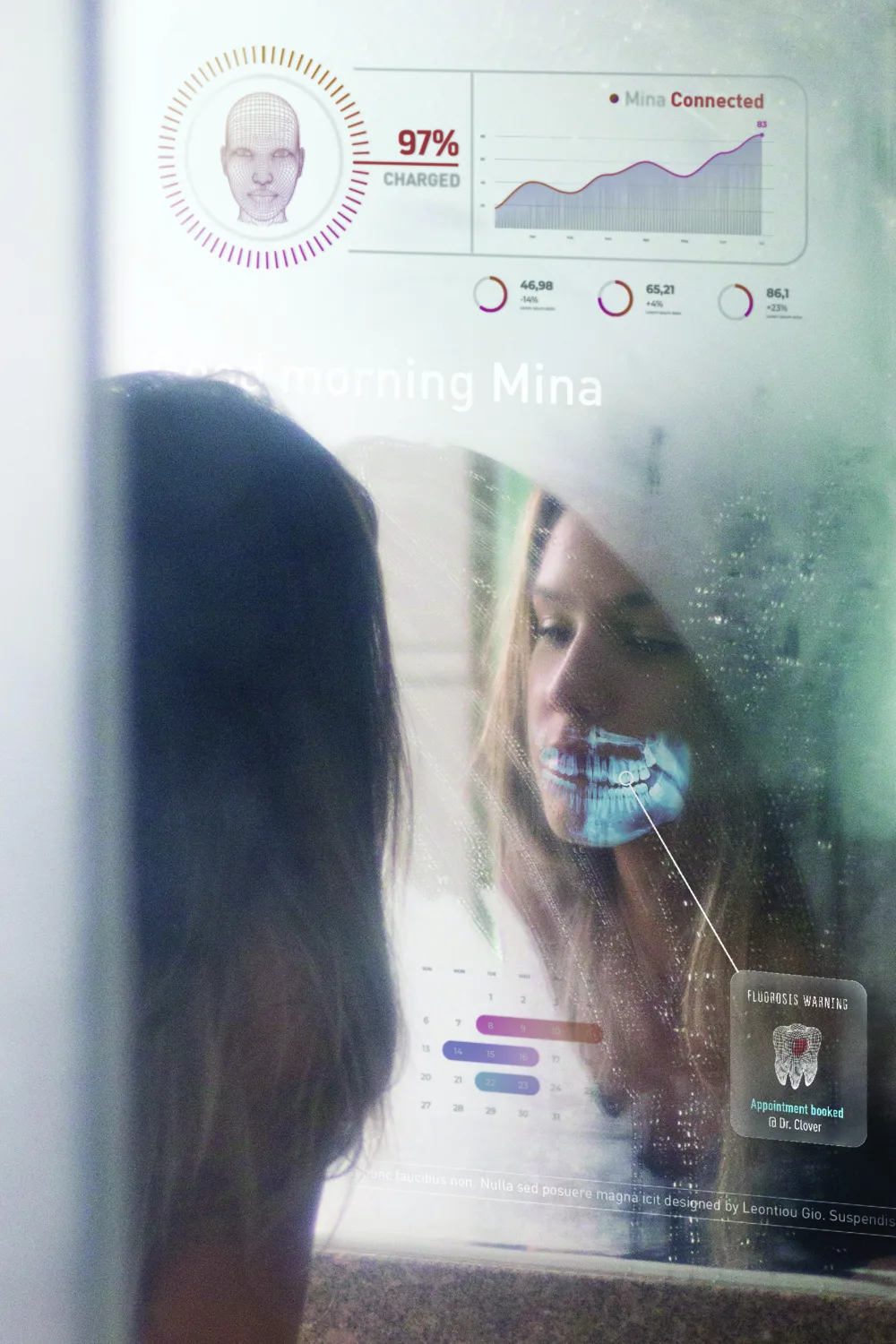
A typical morning in the year 2051. A slender woman, let’s call her Mina, wakes from her slumber, pulling off the EEG sleep mask that induces lucid dreaming and measures brain activity. It syncs with her olfactory transmitter emitting just the right aroma into her bedroom to soothe her emotions and energise her for a big workday ahead. Today’s scent: orange, sea-salt and wasabi, pre-programmed fragrance notes to match happy memories from her childhood. Later today, the sleep mask will provide her with a guided meditation to wind down, based on her interactions throughout the day.
As she walks to the bathroom, she rotates her smart earring to get an accurate reading of her vitals. It’s the latest wearable supplied by her chosen health provider, Nadilla. The size of a small coin, it measures everything from her heart rate and temperature to her blood pressure and blood oxygen levels. It constantly monitors and shares her information with the Nadilla Care Hub – an insurance-cum-health network of connected care providers and AI-bots, powered by wearables and smart home devices.
While Mina relieves herself, a music track with subliminal motivational messages plays. The lighting is automatically adjusted to exactly the right level to coax her into waking according to the alertness level detected by her sleep mask. The daily news loads on the smart mirror above her sink. It also displays a suggested workout routine (she’s been neglecting her core training), tips on improving nutrition and warnings on UV and pollen levels. Before flushing, her smart toilet analyses her urine, reporting that she needs to up her calcium intake and that she will be ovulating in three days’ time.
An AI-enabled camera fitted inside the plumbing discreetly captures photos of her stool to track her digestive health. It also closely monitors other Nadilla customers in her building and neighbourhood to quickly detect disease outbreaks or other worrying trends. Mina doesn’t love the idea of her most intimate details being analysed, but it’s one of many necessary checks she does to enjoy unlimited free health services on the Nadilla plan.
Before brushing her teeth, she spits a small saliva sample into a Nadilla lab kit to instantly test for thousands of diseases on their database – prioritising outbreaks prevalent in her area. If an infection is noted, it automatically fires off a message to her local pharmacy to dispense the necessary medication straight to her door. In case of something more serious, a chatbot will schedule a video call with her in an hour’s time to discuss additional treatments. Equipped with deep learning algorithms, the AI-empowered bot will interview Mina about possible symptoms, then refer her to a human specialist. She’s had a skin cancer scare in the past, so she will be asked to scan a photo of her skin ailment into an app. This will put her in direct contact with a dermatologist if it has to be treated or removed.
Mina is going through a painful break-up, so her mental health is closely monitored by an AI speaker that engages her in conversation and checks for signs of depression. Today they are chatting about Mina’s weekend plans to travel by submarine to a sub-terranean island retreat. The bot reminds her that her mandatory one-month check-in with a life counsellor is coming up the following week.
For breakfast, Mina whips up a smoothie of bio-engineered supplements – custom created for her by Nadilla – while her smart fridge suggests (and orders) her perfectly nutritionally balanced dinners for the week. Finally, when she steps outside, she straps on a breath biopsy device to track biomarkers in her exhaled breath for early detection of cancer, and if the chest infection she had a few weeks ago has settled down. At the same time, the mask will detect any hazardous airborne pathogens that might make Mina ill.
All these checks take her almost no time at all, and while she gets on with her day, data in the form of images, sounds, emotions, DNA, vitals and other indicators are shared and analysed across a massive ‘health flight centre’. Welcome to the next generation of proactive healthcare.
// The science behind it
A new world of all-inclusive subscription healthcare
Our healthcare system is by nature reactive. You get sick, you go to the doctor, you get treated and get better. You don’t speak again – they don’t check back in with you and you don’t really take responsibility until the same thing happens again. For decades, this economic model has worked for healthcare professionals because they make more money the sicker patients are. But this isn’t very user friendly, is it? It doesn’t make us healthier and more conscious as a society, or incentivise us to take better care of ourselves.
What if this model can be completely turned on its head? We predict that, by 2051, we will no longer pay doctors to cure us when we're sick. Instead, all treatments will be free. We’ll pay an ongoing subscription to a healthcare provider, who will offer a completely holistic mental and physical health service. We’ll choose this provider very carefully – much as we take time to compare internet or mobile phone packages. Once decided, we’ll commit to wearing their wearables, kitting our homes out with smart devices and being injected with their nanobots (designer medicine).
Virtual assistants and human health experts will monitor our vitals 24/7, sending us tailor-made food recommendations, sleep alerts and specialised workouts, much as we described with the Mina example. They will remotely tell their nanobots where to go for interventions and check-ups. If we get sick anyway, treatment will be covered by the health provider because they failed in their service.
While this model might sound new or even ridiculous, it’s formed the basis of Chinese medicine for thousands of years. The prevention of disease and the maintenance of health the Chinese way is a total lifestyle, where you pay a doctor a retainer when you are well, and you don’t have to pay when you’re sick (since the doctor failed you). Through acupuncture, herbs, diet and lifestyle guidance, the doctor will nurse you back to health – and then you’ll start paying again.
By encouraging patients to be more involved in their own care through constant health monitoring, it will be much easier to intervene early on – before a condition becomes acute. Imagine knowing the moment cancer cells start to grow, if gallstones are forming or your thyroid is suddenly underactive. Just think of the cost savings of fewer people needing hospitalisation, chronic medicine or other expensive interventions. Picture the reprieve for hospitals if new viruses can be instantly detected – even obliterated. The reward far outweighs the alternative of not knowing, and people will happily pay for a more effective model if it means all care will be free.
Sounds far-fetched? Apple and Amazon think otherwise
Teaming up with Berkshire Hathaway and JPMorgan Chase, Amazon sadly failed to get its healthcare project Haven off the ground. Not giving up, the company opened up their Amazon Care programme to other companies in 2021. The app offers a range of urgent and primary care services, including testing, vaccinations, treatment of illnesses and injuries, preventive care, prescription requests and more (aided by its acquisition of an online pharmacy). It’s working on health add-ons for Alexa too, so it’s conceivable that this service will gradually spread across the US and maybe even the world.
Meanwhile, Apple also trialled plans for a personalised subscription-based programme with its own employees. This primary care service would integrate data from devices like the Apple Watch with clinical care. The tech giant even took over a clinic space to test the programme, but it was halted when employees questioned the integrity of data collected through the services.
As for wearables and implants, technology is advancing at breakneck speed. Engineers from Rutgers University–New Brunswick have created a smart wristband with biosensors that monitor the counts of different cells in our bloodstream through tiny pinpricks – a bit like a FitBit on steroids. Imagine sending constant blood samples to your doctor, without the hassle of a lab test. Physicians will have a 24/7 real-time dashboard of their patients’ wellbeing and will be alerted to any changes requiring urgent attention. Sensors like Abbott’s FreeStyle Libre 3 have not only transformed life for diabetics but also shown that implants are going mainstream. This tiny arm patch automatically sends minute-by-minute glucose values to a smartphone, which the patient share with selected people.
Health trackers are quickly progressing from wrists to elsewhere. For example, the Oura ring must be the best-looking health tracker on the market right now, giving you eye-opening insights into your body and well-being from the arteries in your fingers. Another sleep tracker, the Neuroon EEG mask, is completely open-source – ready to play with whatever IoT devices you have in your home.
The quest for predictive medical data mining may well take things underground, so to speak. Scientists at Stanford University published a paper on a disease-detecting smart toilet that also examines fecal matter and urine to determine the user’s health. Japanese toilet maker Toto has already unveiled a concept ‘wellness toilet’ claiming the same capabilities.
If all things toilet-related make you blush, you may be more excited by the completely non-invasive Breath Biopsy by Owlstone Medical. It’s used to measure the more than one thousand volatile organic compounds (VOCs) found in exhaled breath, as well as microscopic aerosol particles from the lungs and airways. Both VOCs and breath aerosol represent rich sources of biological information, helping to spot conditions like cancer.
Your smartphone – whatever it will look like in 2051 – will continue to be your health ally. Take Google’s Derm Assist app. Powered by Google's artificial intelligence and machine-learning capabilities, it can analyse photos of your skin and look for a match in a database of 288 skin conditions. It then presents you with some possible skin conditions, with a success rate of up to 97%.
The connected healthcare model is not only designed for the super-wealthy. Technology will finally force a fragmented health sector to put the power in the patient’s hands and provide quality care for all. As the World Health Organisation rightly pointed out over a decade ago, strengthening health systems is ‘everybody’s business’. We can’t forever outsource it to professionals and not take responsibility for our own lifestyle choices. Technology will continue to evolve and we’ll have a wealth of data spread across a dizzying array of devices and providers. An exciting opportunity remains for someone to bring all of this together in a sustainable model.
// Sources & further reading
- https://www.springwise.com/smart-wristband-monitors-blood-cell-count/springwise.com
- https://www.telegraph.co.uk/wellbeing/future-health/connected-healthcare/telegraph.co.uk
- https://www.lumen.me/lumen.me
- https://www.cnet.com/health/personal-care/google-will-now-help-you-identify-that-suspicious-mole-or-rash/cnet.com
- https://www.kickstarter.com/projects/intelclinic/neuroon-open-smartest-sleep-dreams-and-meditation?ref=nav_searchkickstarter.com
- https://www.owlstonemedical.com/science-technology/breath-biopsy/owlstonemedical.com
- https://www.telegraph.co.uk/wellbeing/future-health/healthcare-predictions/telegraph.co.uk
- https://time.com/collection/best-inventiontime.com
- https://tectales.com/wearables-sensors/tectales.com