10Mobility· UX Team
Around the world in 0.8 day
// A story from 2051
It's Friday morning and Jolene is feeling uncharacteristically nervous. Ever since she attended that metaverse meet-up on the quayside in Darwin, Australia two weekends ago, her life has turned upside down. Her healthcare provider keeps pinging her alerts – terse reminders that her recently uneven heart-rate needs to be seen to straightaway. The smart screen on her desk hasn’t held back either – apparently her day-dreaming time was up 47.95% this past week. Her wardrobe keeps suggesting outfits in shades of red with some interesting hemlines. And the home fridge keeps proposing ridiculous mid-week supper ideas, in an irksome, nudge-nudge-wink-wink electronic voice that Jolene hasn’t heard the appliance use. Last Tuesday it was cryogenic oysters, glacier-grown strawberries and an organic Prosecco. Every time she arrives home, the lights dim, soft music cues up and she almost trips over the cat. Things are a mess. And they have been from the minute she locked iridescence on Noah, the Australian marine biologist. On Monday, there’d been a message from him to say he’d be in New York tomorrow for an old-school, face-to-face conference, and then coming on to Florida that evening to take samples of the mangroves for a new sustainability project. The AI travel agent has sent her his itinerary. Could this really be happening?
Friday morning. Darwin, Australia. Noah tips his suitcase lid down and locks it with his fingerprint. He takes a last look at the itinerary flashed in front of him and steps out of his front door, just as the A.I.ber glides up to collect him. His A.I.ber driver doesn’t lack for smalltalk, so the fourteen-minute journey to the speedport is quick, leaving him with ample time to catch the 07.42 to Brisbane. Inside the speedport, a HoverCart takes him straight to platform 42. Noah settles into his seat and watches the scrubland and gum trees of the Northern Territories glide past him as the maglev train reaches its 950km per hour cruising speed. He can still recall the first train trip he’d ever taken, as a six-year old to Alice Springs - an overnighter back in ’31. He smiles. Then he remembers the nostalgi-feature on his armrest that mimics the sound of a ‘real’ train when activated. He selects the quaint, Thomas the Tank Engine emoji. In seconds, his headset is filled with the clitter clatter of his boyhood travels, the seat gently reverberates, and Noah is sound asleep.
Three hours later, the TrolleyBot is gently prodding him awake. There’s just enough time to admire the Queensland scenery and enjoy a protein-enriched smoothie before the maglev train glides into Brisbane. Once at the Brisbane speedport, Noah boards a hyperloop shuttle to the airport. He recalls his parents telling him how they used to have to be at the airport two hours before take-off. That was before biometric passport control and superfast luggage scanning. Now the check-in time is less than fifteen minutes, and when the travelator gets him to his flightcraft, he is welcomed aboard by the AttendantBot Stacey565. There’s an onboard announcement that – as the flightcraft has just landed from Singapore, the hydrogen fuel levels are being checked before take-off.
As the flightcraft lifts and bends its way up and out across the Pacific, Noah is disappointed not to be sitting next to an actual window, but he’s chosen this airline because the windowless craft can cut five hours off the flying time to JFK – down to four hours, thirty-seven minutes. A nine-odd hour journey, door to door. Which should get him to his conference in time for the 10am start. And besides, all around the interior, constant updates and footage of the route are played on the window-shaped monitors. It’s a nice touch for those who hanker after the Dreamliner days.
As the flightcraft enters Hawaiian airspace, Stacey565 serves up lunch, along with a small shot of FliteElixir to combat jetlag. And then, in what seems like no time at all, the flightcraft is dipping and banking towards the Manhattan skyline. How small the Empire State looks on the monitors, next to its neighbouring skyscrapers. It’s almost the fiftieth anniversary of 9/11. His grandfather had been working in the North Tower that day – seconded from the Sydney office – and had only just made it out. He snaps a pic to send to Grandpa and offers up a short prayer of thanks.
Once on the ground, Noah takes the subtramway to his conference venue on the Upper East Side. The journey has been shortened, thanks to advances in battery-powered, underground tram engines. The conference is due to wrap up at 17.00, which should be ample time for him to catch the 18.07 quick-hop to Palm Bay, Florida. As he takes his seat in the auditorium, he checks his antique Rolex Submariner – a gift from his father – yet again. Was it a bit too soon to be suggesting an actual meet-up with Jolene this evening? Only ten hours left to find out.
19.30, Palm Bay. Jolene makes her way to the SmartHeliPort at the top of her building. There’s a HeliTaxiV1 already waiting, and at her voice-command, the door opens, she climbs in, and the craft takes off for the airport. The monitor on her seat has detected from the voice command that her throat is dry, and a bottle of filtered water is lifted out of the fridge for her on a small, robotic arm. She sips it, gratefully, and watches as a small, domestic flightcraft dips, banks, and lands expertly on the recycled plastic tarmac. Looks like it could be the one from New York. She scans it with her phone camera and receives the flight number. It’s a match.
A quick hop on the speedevator, and she finds herself at Arrivals. There’s a familiar figure on the other side. She feels a knocking in her chest, and the bracelet monitor goes into overdrive. She looks down at her latest heart rate readings. With a smile, she de-activates the device. There will be recriminations of course, when she puts it on again after the weekend. But that’s OK. She’ll take her chances on this one.
// The science behind it
Planes, trains and hydromobiles
In the early part of the 21st century, and in the first shift away from petrofuels, electricity was championed as the cleaner alternative. Electricity was mainly used for short-haul drive vehicles. However, its shortcomings prompted the development and usage of great petrol alternatives like hot air, hydrogen, helium, and biogas. Over time, all the heavy goods vehicles (HGV’s) for long-haul trips were powered by hydrogen and helium.
Biogas was used well into the early 2030s. This was a mixture of various gasses, mainly methane and carbon dioxide produced from raw materials like food or agricultural waste. Its initial purpose was that of providing heating and electricity, but it was soon mostly used for the production of green hydrogen.
Over the decades, due to the rise of autonomous vehicle taxi services, mobility as a service (MaaS), shared shuttle services (including mini-shuttle buses), there was a massive drop in car ownership. By 2051, it’s become a rarity for anyone to own a car . Those that do are unlocking it, using either their biometric data or the power of their minds. Biometric data was popularised with the usage of smartphones, but car manufacturers went a step further to ensure users’ vehicle safety. Such vehicles are controlled via a device attached to the user's head. The device measures brain activity and translates it into car actions. The device placement procedure is non-invasive; consisting of solid electrodes that are easily attached and detached to the skin. This gives the user plenty of options to control the car via the device, from unlocking through to driving. Now, disabled people can drive just as easily as their able-bodied counterparts.
In the case of mini-shuttle buses, passengers would use the app to track shuttles’ location in real-time, with each being a few minutes apart. If the shuttles are going to the same destination, e.g. airport terminals, they would eventually attach themselves to one another, and then start detaching on different terminals. If electricity reserves were running out, shuttles would simply drive themselves to the nearest wireless charging station.
The charging stations were a challenge to develop, as they had to protrude high enough not to waste electricity. The solution was to design flat stations that would slowly protrude upwards only once the vehicle was parked on top of it, and until the contact point at the bottom of the vehicle was reached. Thus, vehicles of various heights were able to use it seamlessly.
Individual car owners had their own battery charging stations. And with each car coming with two batteries as standard, battery charging, and replacement, was a simple matter. One battery could be charged at home, while the other battery could be exchanged for a full one at a battery replacement centre, with no valuable time wasted.
By the middle of the century, air travel had undergone significant changes. In order to cut airfare costs, airplane companies started producing planes without windows. Windowless planes turned out to be a much more sustainable solution. Not only were structural weaknesses eliminated, making them safer, lighter, and faster, but they were also cheaper to produce and needed far less energy to run. Windows were instead replaced with interior screens. Users could choose between several viewing options, from daytime to night-time to entertainment mode.
Zeppelin-like crafts, called blimps, gained in popularity due to their cost-effectiveness. Unlike a zeppelin, with its rigid metal frame, a blimp is inflated like a balloon, and its shape can therefore be more flexible. Although more expensive than hydrogen, helium was a less combustible gas, and it became widely used in blimps. Combustion engines were replaced with hydrogen batteries, which increased their safety. However, hydrogen was still used in heavy duty vehicles such as planes and road cargo vehicles.
Much like autonomous vehicle networks on the road, by 2051 we now have airborne ones, with numerous autonomous aerial vehicle (AAV) taxi services to choose from. Scheduling a craft reminiscent of the earlier helicopter is now as easy as once calling an Uber. At first, these were remotely controlled by operators in control centres; after which they became fully autonomous with no risk of human error. Human intervention was needed only in cases when the vehicle’s internet network stopped working and had to be temporarily switched to another provider’s 5G network, thus taking advantage of the network’s flight data collection capability.
Some of these AAV companies collaborated with road autonomous electric vehicles (EVs). Since AAVs could only travel long-haul, these were used as taxis, which would move and attach passenger capsules to the nearest EV taxi without a capsule. This concept was proven to be highly efficient in busy metropolitan cities. Each building’s rooftop was equipped with multiple 6-place passenger capsules. Once the trip was executed, AAVs would deliver back the capsule to the nearest empty rooftop capsule space.
Personal AAV usage was restricted to hoverbikes that were also utilised by delivery companies for small and lighter goods. AAVs were first popularised on the Mediterranean coast and the Middle East, where plenty of houses already had flat roofs that could be used as perfect landing and storage space.
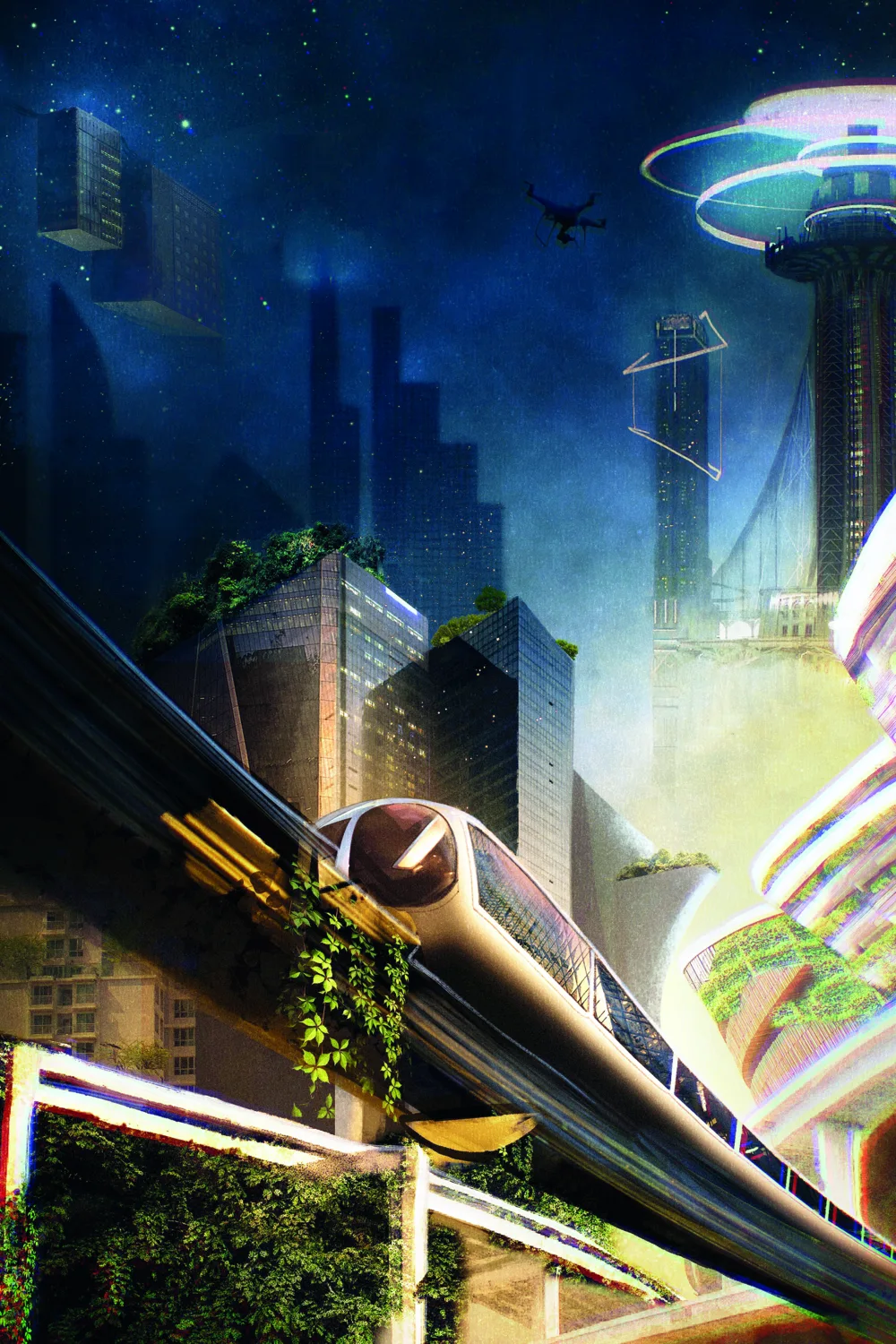
By 2051, railways use magnetic levitation, ormaglev systems. Rails are placed above the earth’s surface and supported by columns. Trains move either on top of the rails or are suspended under them. Maglev technology involves the use of two sets of magnets. One set pushes the train up off the track, while the other moves the elevated train ahead, causing a lack of friction. These railways were used for passenger travel, whereas underground rail (tube) systems were mainly used for freight. Tube systems are essentially the same as maglev but sealed, which allows for minimal resistance and friction, due to the absence of air.
Ever since the 19th century, when one of the earliest designs for a spacecraft was conceptualised by Konstantin Tsiolkovsky, we humans dreamed of space travel. Twentieth century scientists used rockets to travel into space. The cost of these spatial expeditions – combined with the cost of rocket production – meant there was a need for a more sustainable solution. However, once we had acquired the capability to visit Mars in the early part of the 21st century, space travel became an exciting new space for innovation. By 2051, the Chinese may well have completed the construction of a full-blown, colossal space elevator, extending 35.000 kilometers from the Earth’s surface and reaching geosynchronous orbit. It’s predicted that the USA and Russia will be building their versions. Two main reasons abound for wanting to reach the top of this elevator. One is space tourism, while the other is space exploration. However, in 2051, space exploration is reserved exclusively for members of the (CNSA) China National Space Administration.
Stairway to heaven? Or an elevator?
There’s ample proof that the world is moving towards electricity as the more sustainable solution. However, its shortcomings, like storage, and its inability to replace fuel for heavy or long-haul tasks, are becoming more apparent by the day. A great example of a failed attempt to support electricity production was that of the solar panel roads that used one-third of the electricity they generated, just to power their built-in LED lights to increase night-time visibility. Their creators didn’t consider leaves, snow, or heavy traffic covering the roads either.
This is where green hydrogen comes into the spotlight. Compared to 31.9 terawatt-hours of electricity generated by biogas in a year, biogas could generate almost double the amount of hydrogen, totalling 58 terawatt-hours via steam re-forming. Steam re-forming is a method of producing hydrogen by the reaction of hydrocarbons with water, whilst using biogas as the feedstock.
Biometric data is already a part of car purchase packages. Already, Hyundai Santa Fe owner can unlock their vehicles with fingerprints instead of keys. Multiple drivers can register their fingerprints, and depending on the fingerprint in use, the car will automatically adjust seat positions as well as the angle of the rear-view mirrors.Being able to do so only using the mind is not too far-fetched either. Mercedes-Benz is trying to make it a reality. In 2020, they unveiled the AVTR Vision car that recognises drivers by their breathing and heartbeat. The owner of the car can wear a device with electrodes at the back of the neck that reads brainwaves and translates them into car actions. The car is not yet for sale, but the prototype’s test rides look promising.
Mobility as a Service is undoubtedly on the rise, and so is the development of autonomous vehicles. Plenty of autonomous driving technology development companies are trying to be the first ones to put fully autonomous vehicles on the road. Such vehicles are Waymo, Zoox, Zoe, Apollo Cruise and Motional, with big companies providing funding, such as Google, Amazon and Baidu. These autonomous EVs – also called robotaxis – are still in their testing phase.
The S3 or shared shuttle service is a pilot project by Kelois, testing autonomous electric vehicles in the city of Gothenburg on behalf of local public transport authority Västtrafik. The shuttles, made by Navya, have a maximum speed of 20km/h and can carry up to eight passengers. Charging takes five hours, and the vehicles can run for up to seven hours on one charge, depending on weather conditions.
Wireless charging is something BMW already offers. The charging system consists of a charging pad or station, with the primary coil to be installed in a garage or outdoors. The secondary coil is under the vehicle. An alternating magnetic field is generated between the two coils, through which electricity is transmitted without cables or contacts at a charge rate of up to 3.2 kW, allowing for the battery to be completely charged after three and a half hours.
Battery swap stations are something already being developed. As of today, car producer NIO has built 301 NIO Power Swap stations, 204 Power Charger stations, and 382 destination charging stations in China and completed more than 2.9 million swaps and 600 000 uses of One-Click-for-Power services. The reason our vision predicts two batteries in the cars is that you must swap your initially perfect battery that comes with the car, with the one that perhaps doesn’t have a 100% battery health anymore and will hence drain faster. Keeping the ownership of one battery could make us more likely to hop on the battery swapping trend.
Though we’re so used to flying planes with windows, it might become a thing of the past. In 2018, Emirates Airline unveiled a first-class suite in one of their Boeing 777 aircraft that features virtual windows that project images from outside of the aircraft. Emirates president Sir Tim Clark regards the endeavour as the first step to windowless planes.
Zeppelin-like aircrafts are making a comeback. British company HAV (Hybrid Air Vehicles), announced plans to enable short-haul flights for city-hopping in their Airlander 10 blimp. HAV calculated less than a tenth of the carbon footprint created for the same journey conducted with a blimp, than with a conventional jet plane. Their blimp uses helium as a lifting gas. Other companies heading towards blimp production include US company Lockheed Martin, French Flying Whales, and Israeli Atlas LTA. Even Google’s co-founder Sergey Brin is investing $150m into the creation of a 200-meter blimp, expected to be the largest of its kind, with some sources claiming it’s to be used as a luxurious “air yacht”, and others saying it’s to be used to deliver necessities to remote locations on humanitarian missions.
Toyota, Uber, Hyundai, Airbus, and Boeing are some of the companies working on the development of flying taxis. A select few are already working on autonomous aerial vehicles or AAVs. One such example is Ehang's Ehang 184. This 1.77-meter craft resembles a large drone, can reach 130km/h and is made to be eco-friendly, secure, autonomous and suitable for short and medium-haul transport.
Combining EV taxis and AAV’s is also an existing concept. Audi, Airbus and Italdesign’s Pop.Up Next includes a passenger capsule that is delivered by a drone to the nearest taxi available. The concept is currently being showcased and tested using 1:4 scale models.
We could also soon see bicycles moving from the roads to the air. UK’s Malloy Aeronautics and Russian Hoversurf have already developed hoverbikes. Hoversurf has moved fast from prototyping to commercial use by revealing a deal to sell the bike to the Dubai Police and later passing US federal Aviation Administration ultralight vehicle classification requirements.
While only six commercial maglev trains are operating at the moment, it’ll be interesting to see whether there will be more of them due to their energy efficiency, quietness, reliability, high speed, and low maintenance. There are three in China, two in South Korea, and one in Japan. A type of maglev evolution system is Virgin’s Hyperloop, which is different to the traditional maglev system in that it’s a sealed tube system, removing additional air resistance. Virgin Hyperloop is currently being tested in the desert outside of Las Vegas.
And finally, a space elevator is being considered at the moment as well. NASA claims the concept of the elevator is sound, and communities of researchers around the world have shown optimism towards building one. China wants to build one as soon as 2045. A research team at Tsinghua University in China has patented the technology and published part of their research in 2018, where they explained how the fibre they created could be used to build the space elevator. According to the team, one cubic centimetre of the fibre, which is composed of carbon nanotube, would sustain the weight of over 800 tonnes.
One thing is for sure, innovative transportation solutions can be rapidly developed, but implementation is incredibly slow in contrast. Transportation is heavily monitored by governments and influenced by the governing parties representing their interests and those of the population. And on top of the challenge of creating vehicles and systems safe for the users, there’s the need for them to be safe for the environment.
The majority of the technology mentioned is available but not mainstream yet. Or it’s prototyped but not yet properly funded for mainstream production. Maglev is a great example of a system introduced in the 1940s, but which has not received the attention it deserves. It is possible that Virgin's or SpaceX's Hyperloop will popularise the concept. However, most governments consider it more cost-effective to repair existing railways than to replace them with maglev. Which is true, but only for the short-term, as the costs of traditional railways for users, governments, and the environment quickly add up.
Innovations on the road are more likely to come sooner, like autonomous personal vehicles and taxis. But there are some reservations regarding aerial vehicles. Firstly, we’d have to sacrifice either usage of drones, personal aerial vehicles, or taxis as there’s just not enough space in the air for all of them. And since there are no rules in place on how to regulate air traffic roads above cities, it would be hard to design aerial vehicles to fly autonomously. There’s also the lack of landing areas. There are just not enough flat, sizable places where crafts can land. The aircraft, in general, are also very loud and would lead to noise pollution. Powering them on electricity is not an option either as they would need too much of it to fly. On the other hand, we’ll be seeing a lot more aerial vehicles, such as are the zeppelin-like blimps.
A superstar element not gaining the attention it deserves due to electricity taking all the spotlight – is hydrogen. Due to misconceptions and inadequate education on how it can be sustainably produced and stored, it is routinely overlooked. Data on hydrogen is widely available. But perhaps, with so much invested in electricity, there may be too much at stake to find a replacement.And, although there’s skepticism surrounding our ability to take an elevator to space, we’ll definitely be able to do so, but probably not as soon as 2050.
SOURCES
Colossal elevator
Foundation, 1951, Isaac Asimov; mentions of gravitic repulsion elevator
http://www.technovelgy.com/ct/content.asp?Bnum=26
The Fountains of Paradise, 1979, Arthur C. Clarke; mentions of space elevator
http://www.technovelgy.com/ct/content.asp?bnum=720
Lunar space elevator
https://en.wikipedia.org/wiki/Lunar_space_elevator
Bike lanes
https://www.good.is/articles/polish-glowing-bike-lanes
Hyundai unlocking via biometric data
Mercedes that can be controlled by mind
https://www.youtube.com/watch?v=ChqM3zqTREQ
Keolis shuttle busses
Google’s Co-founder building blimp
https://futurism.com/the-byte/google-co-founder-gargantuan-blimp
Emirates president says they’re looking into windowless planes
https://www.bbc.co.uk/news/business-44383220
NIO battery swap
https://www.caranddriver.com/news/a33670482/nio-swappable-batteries-lease/
Ehang 184 AAV
https://www.ehang.com/ehangaav
Hoverbike by Malloy Aeronautics
Hoverbike S3 by Hoversurf
https://www.youtube.com/watch?v=GQMGq8gk6QM
Aptiv Self-driving taxis
Maglev
https://en.wikipedia.org/wiki/Maglev
Hyperloop
https://en.wikipedia.org/wiki/Hyperloop
Aeromobil
Audi Pop Up Next concept
Green hydrogen
https://www.h2-international.com/2020/09/15/green-hydrogen-from-biogas/
BMW wireless charging
https://www.youtube.com/watch?v=GlrcPrzuPMM
Solid gel electrode
Airlander 10
https://www.hybridairvehicles.com/our-aircraft/airlander-10/
// Sources & further reading
- https://www.aeromobil.com/aeromobil.com
- https://www.aptiv.com/aptiv.com
- https://www.caranddriver.com/news/a33670482/nio-swappable-batteries-lease/caranddriver.com
- https://www.bbc.co.uk/news/business-44383220bbc.co.uk
- https://www.youtube.com/watch?v=GlrcPrzuPMMyoutube.com
- https://futurism.com/the-byte/google-co-founder-gargantuan-blimpfuturism.com
- https://www.youtube.com/watch?v=GQMGq8gk6QMyoutube.com
- https://www.hover-bike.com/hoverbike/hover-bike.com
- https://www.hybridairvehicles.com/our-aircraft/airlander-10/hybridairvehicles.com
- https://www.youtube.com/watch?v=ChqM3zqTREQyoutube.com
- https://www.good.is/articles/polish-glowing-bike-lanesgood.is
- https://www.nbcnews.com/mach/science/colossal-elevator-space-could-be-going-sooner-you-ever-imagined-ncna915421nbcnews.com
- https://www.forbes.com/sites/jeanbaptiste/2018/12/27/hyundai-motor-lets-drivers-use-fingerprints-to-unlock-and-start-new-car/forbes.com
- https://www.researchgate.net/publication/229554772_A_Non-Adhesive_Solid-Gel_Electrode_for_a_Non-Invasive_Brain-Machine_Interfaceresearchgate.net
- https://www.ehang.com/ehangaavehang.com
- https://en.wikipedia.org/wiki/Lunar_space_elevatoren.wikipedia.org
- https://en.wikipedia.org/wiki/Magleven.wikipedia.org
- https://en.wikipedia.org/wiki/Hyperloopen.wikipedia.org