06Agriculture· Vision Team
Give a man a Crispr and he’ll eat forever
// A story from 2051
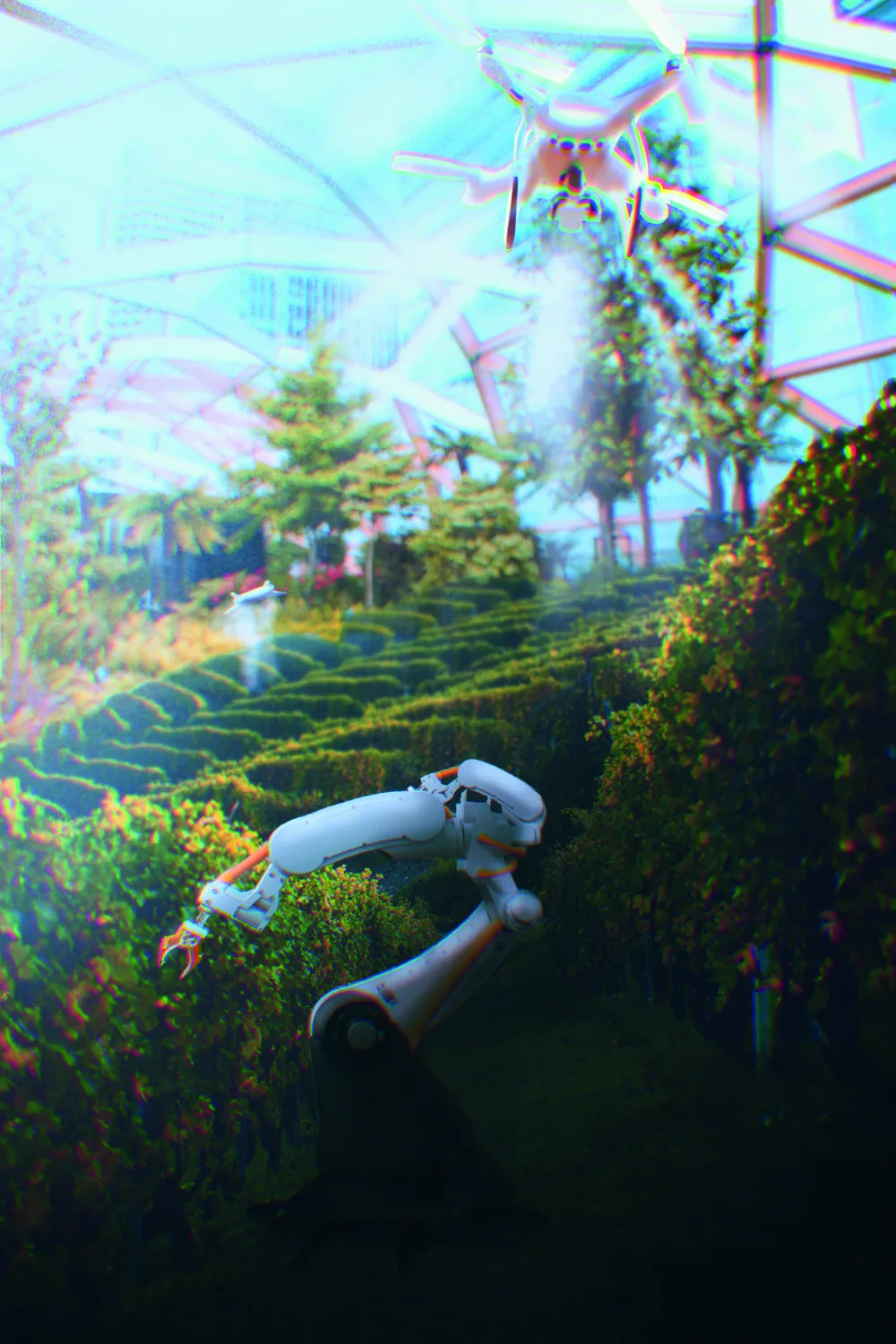
Tom is daydreaming about augmented reality wine labels and munching on a Blue Java banana (that is actually blue). A beep from his app alerts him that the next check is due on his vines. His office is bathed in the warm pink light of the luminescent solar panels that cover the windows. Made from fruit and vegetable crop waste, it converts UV light into electricity even when it’s cloudy (as it usually is in Glasgow). He flicks on a monitor and selects the view from one of his bumblebee drones. Wearing a tiny backpack camera, this bumblebee not only gives him the ultimate bee’s eye view, it also flies around as a tiny pest controller. On its feet is an organic, inoculating fungus that it gently distributes on its foraging journey.
Through the bee’s infrared sensor, the system picks up a temperature change and calls for a vine bot to take a closer look. A robot wheels over and takes a quick soil sample. The verdict: increase fertilisation. Soon a fine brown mist is sprayed over the soil – a completely odourless nutrient-rich ‘worm juice’ that has been rehabilitated from biosolid sludge. Tom finances most of his winemaking business through the carbon credits he earns by repurposing the waste of his apartment block. Money down the toilet? Most certainly not.
It’s lunchtime and Tom decides to check on his merlot grapes and maybe enjoy a glass with his cultured meat sandwich. He steps outside his office and takes an elevator up six floors onto his rooftop vineyard. On the way, he passes the coop of dodos he is currently breeding. When companies started de-extincting animals like the woolly mammoth in the 2030s, it was only a matter of time until someone brought back the Mauritian mascot. Little did we know that its eggs are naturally low in cholesterol.
On the rooftop, Tom steps out to admire his gene-edited histamine-free chardonnay grapes alongside rows of anti-ageing merlot. As Louis Pasteur once said: “Wine is the most healthful and most hygienic of beverages.” Turns out, he was right. Ever since scientists started tinkering with engineered yeast, they’ve been able to ramp up the amount of the healthful component resveratrol. This has finally led to the holy grail of winemaking: wine with no hangover. What’s more, the wine club of 2050 features wines bred for specific anti-ageing benefits, heart health and fighting dementia. Bottoms up!
// The science behind it
Farming of the future
The world of 2050 is bound to be a more wholesome, bountiful place through agriculture. By then, Agriculture 4.0 will be well entrenched, transforming farming into a well-oiled manufacturing industry. Confronted with climate change, dwindling natural resources and a population explosion, governments, investors and scientists will pool their expertise to achieve the 70% increase in food we’ll need. Imagine if you could bring together the best regenerative farming practices, the most intelligent technology, affordable energy and flourishing gene-edited seeds? That’s the recipe for feeding the world in 2050.
With the help of high-speed data connectivity via nanosatellites, smart farms will use technologies like drones, robots, temperature and moisture sensors, aerial images, and GPS technology. These precision agriculture systems – powered by endless cloud data – will make farms more profitable, efficient, safe, and environmentally friendly.
The dream of farmers remotely monitoring swarms of planter and fertiliser robots will be commonplace. Farms will become like tightly controlled factories that produce consistently reliable products. Thanks to the discovery of CRISPR-Cas9 technology, much more precise genetic manipulation will be possible. Everything will be more convenient and taste better. Sweeter fruits, less allergic reactions, no hangovers. Fruit, vegetable and livestock species will be brought back from extinction. Cattle will be bred to be more heat resistant and cope better with climate change. Crops will be tinkered with to be more nutritional, drought and pest resistant and higher yielding. Consumers will become better educated on the multiple benefits for their health and the environment. They will be more accepting of methods that, in essence, replicate mutations that take place naturally anyway.
The soil and water we will have left will be treated like gold. The world will finally realise that to keep up with a rising food demand, the answer doesn’t lie in more deforestation and more megafarms but working more productively with the soil we have. With one third of earth's soil acutely degraded due to agriculture, regenerative farming will no longer be a marketing buzzword – it will be the new standard. Regenerative agriculture will shift the focus from a yield obsession towards managing a better functioning ecosystem.
The ecological wastelands created by intensive farming practices will be brought back to life by encouraging biodiversity, trapping carbon emissions and keeping soil disturbance to a minimum. Currently the experiments of smaller farm owners, it will spread to megafarms too. The biological product industry (biofertilisers, biostimulants and biological control agents) will be booming. We’ll finally understand that the very health of our bodies is directly connected to the health of our soil. As the food-as-medicine trend expands and we deeper understand the link between human and soil microbiomes, consumers will start demanding that these delicate ecosystems are protected. Scientists will spend the next decades trying to understand how microbiomes in soil, people, oceans and air can be restored and protected before they go extinct. They will discover many fascinating connections between what we drink, eat, breathe and even accidentally ingest (i.e. dirt). Nothing will be taken for granted.
Even for those countries running out of fertile soil, there will be hope. If food can be cultivated on Mars, deserts can be coaxed back to life. Food can be grown in sea or saltwater. And, of course, vertical and urban farming will be huge. An aerial view of food resilient cities will show seas of green – on every possible wall and rooftop, in every possible underground tunnel. Food will be cultivated in supermarkets, malls and schools, parks and multi-story car parks. Everyone will be a farmer, growing food in a cellar, garage or ceiling. Perhaps even right there on the kitchen counter as the Personal Food Computer promised. Food will, literally, be grown from thin air – using energy efficient artificial solar-powered lighting and hydroponics.
Meat on the menu? Yes, very much so. The desire for meat is ever growing. Over the last thirty years, meat and dairy consumption has tripled in low and middle-income countries – on top of already gigantic meat appetites in developed nations. But the meat of 2050 doesn’t have to come from animals. Meat taxes – already discussed in Germany, Denmark and Sweden – will curb meaty cravings. Many will follow China’s lead – aiming to cut meat consumption by 50% by 2030. Soon, cattle farmers will lobby to not call this meat, and we’ll have to come up with a new word like ‘feat’ (fake meat?) for new generations of ‘cytovores’ (consumers of cells).
The animals we do eat will enjoy far more respect as crucial partners in soil preservation – and more of an occasional delicacy. Most of the technology guiding human health will filter down to livestock. Health trackers/implants, breath and stool analysis, gut-specific nutrition and silvopastoral grazing (munching among shrubs and trees with edible leaves or fruits). Livestock will live lovely, coddled lives while they fertilise soil and generate ‘cow power’ electricity with their manure.
The result: meat that is far too flavoursome to waste on nuggets, Bolognese and burgers. For these things, there will be cellular agriculture – growing animal-based protein products from cells, not animals. By 2022, more than 40 companies will already produce bioreactor-grown meat so we can expect a massive influx of meat breweries creating ‘craft’ meats.
Agritech goes mainstream
Big robots, small robots, sensors, tags, drones, beacons – we know future farms will have a lot of them. And they will all communicate with one another, log data on the cloud and report back to a central app. While the farmer sleeps, sensors measure interactions between plants, soils, and animals. Robots, AI and algorithms will work on new food sustainability practices and models. They will creep and fly around your vineyards, fields, tunnels and plant walls, weeding, monitoring, picking, hoeing, seeding and more.
Today, a swarm of six Fendt Xaver robots can cover around 3 hectares per hour – each three-wheeler the size of a souped-up motorbike. Everything about these smart planters makes sense: being battery operated, they emit less CO2, are less noisy and safer to operate than giant machines. Less soil damage, less oil spills, less heat, less power, less pesticides. These robots are green energy ready, able to be powered by a biogas plant or photovoltaic facilities, wind power or fuel cells. And, of course, they can work 24/7 and dramatically increase yield. They can vary seed depth and pressure based on real-time sensing of soil moisture, temperature, humus content and plant residues. All a farmer must do is park the docking station near the field where the bots will operate, fill them up with seed and hit ‘go’ on the app. They automatically go to work, and when they need a charge or seed top-up, they drive themselves back to the charging station. If one stops or jams for whatever reason, another seamlessly takes its place.
In a bid to address the seasonal worker shortage, scientists and mechatronics experts are hard at work to bring farmers fruit picking solutions. These will become a common assistance during harvest time when you could have humans picking during the day and robots at night. Octinion’s autonomous strawberry picking robot Rubion can gently pick berries just like a human picker, without bruising the strawberries. Thanks to built-in quality monitoring, the robotic system allows for sorting, advanced crop monitoring and precision farming. Over in Australia, Monash University researchers have developed a robot capable of performing autonomous apple harvesting. Using cameras to scan the trees, the robot can harvest an apple in around seven seconds. Compared to the four or five seconds it takes a human to pick an apple, this is already very promising. Naio Technologies have three farm friends to choose from: Ted the vineyard weeder, Dino the vegetable weeder, and Oz the...well Oz can do almost anything from weeding and hoeing to seeding and transporting.
Tevel’s FARs (flying autonomous robots) are flying fruit pickers that combine cutting-edge algorithms, AI, and data analytics. They can spot and pick ripe fruit from the sky, and work 24/7. While these types of cobots (collaborative robots) always bring up the question of taking jobs from humans, Tevel believes that a worker shortage will see a useful collaboration between man and machine. What’s more, just because fruit picking is a centuries-old trade doesn’t mean this low paid, repetitive work should exist forever. The World Economic Forum estimates that automation will create 97 million jobs by 2025, more than it will displace. Cobots will augment and enhance human strengths with the precision and data capabilities they bring.
However, flying assistants are not just for affluent countries. In sub-Saharan Africa, the not-for-profit organisation TechnoServe uses remote sensing, drone mapping, machine learning, and satellite data to help boost cashew nut production in the West African country of Benin. This pilot project has been instrumental in helping smallholder farmers know where best to plant their trees and increase the quality and quantity of their yields. These ‘eyes in the sky’ will be game changers for African farmers, helping with everything from land registration and locating livestock to taking inventory of crops and estimating crop yields.
It’s not just crops getting tech upgrades. GEA’s DairyRobot is more than just a robotic milking system – it delivers a precise image of every udder quarter of every cow to quickly pick up differences in milk quality or changes in temperature (e.g. detecting udder infection). Ceres Tag’s solar-powered, satellite-connected smart tags constantly transmit real-time data back to the farmer. They monitor everything from a cow’s location and feed intake to its general health and fitness. MooCall’s smartphone-connected sensors fit onto the tail of a pregnant cow, then send the farmer a text message when the animal is approaching calving. MooCall’s Heat collars and ear tags monitor mounting behaviour and bull activity levels to determine – pretty accurately – when a cow or a heifer is in heat.
One day, these smart collars and livestock wearables will monitor absolutely everything – just as they do with humans right now. Imagine Bluetooth-enabled sweat strips that measure sodium, potassium, and glucose levels. Imagine using the same technology as human breath biopsies to analyse a pig’s breath for nutritional problems. With a smartphone, a farmer will have many apps for on-the-spot diagnoses such as detecting metabolic diseases in cows and pigs from just a few snapshots.
Everything is farmland
In 2050, what we know as farms – big swathes of land on the outskirts of cities – will be something completely different. In fact, in a few decades, everyone will be a farmer. It took a pandemic to boost a huge interest in gardening and urban farming as everyone wants to try their hand at cultivating their own food. From balconies to cellars, from patios to attics, food is being grown without sunlight or soil, with sophisticated growing kits.
Singapore is a promising test case for modern day urban farming. A country that imports 90% of its food, it has set itself the challenge to produce 30% of its own by 2030. With virtually no land to speak of, it’s creating hydroponic farms on parking structure roofs (Citiponics), retro fitting vertical farms into existing buildings (Sustenir Agriculture) and converting unused spaces into greenhouses. Agritech business AbyFarm is leading the farming revolution, with the aim to transform existing high-rise buildings, car parks, rooftops and land into automated, smart remote-control farms. AbyFarm uses intelligent, AI cloud-driven machinery — IoT, sensors, machinery, blockchain, data analysis, high-tech self-regulating farming system – to attain high yield, sustainability, and traceability.
The World Wildlife Fund is also throwing its weight behind research into new ways to lower the massive environmental footprint of growing food. One such project is trying to ignite a vertical farming revolution by bringing together different stakeholders in St. Louis, Missouri. Here, farms are created in naturally cool areas such as a network of underground caves once used to brew beer, cold storage in postal hubs, or in spaces next to power plants that can take the excess heat from an indoor farm and convert that into energy.
In London, Growing Underground grows micro greens and salad leaves 33 metres below the busy streets of Clapham. Here, in this entirely artificial environment – World War Two bomb shelters in a previous life – they grow food in just two weeks to have it on your plate in four hours – a locavore's dream. With the help of hydroponic systems and cutting-edge, LED technology, crops are grown year-round in the perfect, pesticide-free environment using 100% renewable energy. Everything – from temperature to illumination – is monitored closely by sensors, with data sent directly to Cambridge University’s engineering department to work out new routines for future crops. Coriander, for example, can now be grown in 14 instead of 21 days, and research suggests that this accelerated growth could work for carrots and radishes too. While this may not overhaul the potato industry overnight, these precise controls of indoor farming spell an exciting future for agriculture.
Vertical farming – the sky’s the limit
With massive innovation in lighting technology over the years, vertical farms have gone from science projects to proper legitimate businesses. Aerofarm, Bowery, Gotham Farms and Plenty are some of the names to watch. These businesses have big goals and celeb funding to match. Robert Downey Jr. is funding Ÿnsect, while Bowery has attracted investment from Natalie Portman and Lewis Hamilton.
Highly efficient, indoor vertical farming is what German start-up Infarm excels in. Their innovative modular farms can be found in over 30 cities in the world – including more than 1300 supermarket aisles (e.g. Marks & Spencer in the United Kingdom and Kroger in the United States). In 2021, the company released new, high-capacity, cloud-connected Growing Centres. Its vision: a globally interconnected, sustainable and highly efficient farming ecosystem, with 100 Growing Centres by 2025. Each centre is designed to function both as a local farm and a distribution centre. It comprises dozens of modular farming units (standing 10-18 metres high) and occupying a 25 square metre ground footprint. Taking just six weeks to build, it promises to yield the crop-equivalent of 10,000 square metres of farmland. The centres work on the same distributed approach as their in-store equivalents. They use a combination of big data, IoT, and cloud analytics to measure and deliver the precise energy, water and nutrition to individual units, in order to maximise yield and minimise resources used. The entire Infarm network is connected to a ‘central farming brain’ that gathers more than 50,000 growth, colour and spectral data points.
It makes sense for supermarkets to get in on the vertical farm action. Responding to the fact that fresh food in Europe travels on average around 1000 kilometres from farm to shelf, German retailer REWE wants to reduce this to a few metres. Its Wiesbaden Market concept store features a rooftop farm that will, for example, produce around 10,000 kilograms of fresh fish and 800,000 pots of basil. Growing in harmony together, the basil will filter the water while the fish faeces fertilise the plants.
Online grocer Ocado has invested in one of the world’s largest vertical farms by JFC – dubbed ‘The Garden of England’. It will be the size of 70 tennis courts and be able to supply more than 1,000 tonnes of fresh produce to thousands of UK supermarkets, when fully operational. It has also formed a partnership called Infinite Acres with Netherlands-based Priva Holding BV, a horticultural technology provider, and indoor farming experts, 80 Acres Farms.
Don’t think vertical farming will only dish up kale and strawberries. Ÿnsect uses vertical farming to breed mealworms, which are then transformed into food for fish, plants, pets and eventually humans. This has important potential for farmed fish, since trawling the ocean floor for anchovies isn’t sustainable. Ÿnsect’s mealworms can provide fish with a lower-cost, higher-quality protein.
In Singapore, it will only be a matter of time before the Apollo Aquaculture Group has one of the world’s largest vertical fish farms up and running – a whopping eight stories high. It won’t just be the highest fish farm – it will also produce an amount of fish and shrimp that is six times higher than established aquaculture operations in Singapore (measured in fish per ton of water). And finally, Infarm is already developing a breeding programme to adapt grains, legumes and other staple crops for vertical farming. Because, after all, with CRISPR-Cas9, anything is possible.
Opening our minds to gene editing
Gene editing is another hot topic for the future of food. If there was a way to grow plants and livestock that was naturally more resistant to disease, and crops that were higher-yielding, why wouldn’t we pursue it? This is what the NextGen Cassava Project is hoping to achieve. Researchers from this pan-African group are studying cassava genes in the hope to fix its vulnerability to the mosaic virus, plus to improve yield and make it more nutritional. While there is often more focus on grains like wheat and rice, for this African staple to have a higher starch content would be a game changer.
If we can remove pits from cherries, keep mushrooms from browning (already done) and make sweet-tasting leafy greens, why not? With the discovery of CRISPR-Cas9 technology, scientists can now delete or multiply certain genes to stop them producing certain proteins, or to make more of them. Think of a DNA as a string of letters that make up a genetic code. Once we find out what each letter does and how it affects a plant’s performance, letters can be deleted or changed. Gene editing is basically replicating this process, instead of waiting for it to happen. People tend to be fearful of gene mutations, yet plants – even us humans – mutate all the time.
Crop strains created by gene editing are already coming to market, for example, Artesian by Syngenta, and AQUAmax by DuPont. Low or no gluten wheat could be on the cards, nuts that don’t cause allergies, caffeine-free coffee, soybeans that are lower in unhealthy saturated fatty acids, and flax seeds with the same high omega-3 fatty-acid content found in fish. Japan’s heart-healthy, super-tomato might be a Frankenfood for some, yet this is only the beginning. Other genome editing projects in Japan include efforts to breed meatier sea bream, hypoallergenic eggs and higher-yield rice plants.
There are projects under way to breed cattle with less hair, allowing them to sweat more and cool down. Gene editing has been successfully used to produce pigs resistant to the fatal porcine reproductive and respiratory syndrome. Start-ups like Pairwise are focussing on removing pits from cherries and creating sweet-tasting leafy greens.
And what if you could actually count your chickens before they hatch? When breeding layer chickens, the only way to differentiate male from female is after birth. Israeli company EggsXyt used CRISPR to transfer the DNA of a jellyfish into the male chromosome of laying chickens. Working like an egg ultrasound, when a bright light is shone through the genetically modified eggs, the female eggs will show nothing, but the male eggs will appear blue. Voila! No more killing four-billion-day-old male chicks a year, and instead, adding four billion eggs (and extra profits) to the food supply chain.
Healthy soil = healthy planet
Carbon offset projects come in many guises but there will be a continued focus on the role of soil in bettering our climate. It’s simple: healthy soil gives us healthy plants, and nutritious plants give us healthy bodies. Moving towards regenerative farming is the best way to encourage carbon drawdown and maintain healthy soil from turning into dirt. When we speak of healthy soil, this is an intricate web of fungi, bacteria, nematodes, mites, termites, and earthworms that all work together for properly functioning soil. Microbes fix nitrogen from the air into soluble nitrates that act as natural fertilisers; a deeper understanding of them will be an exciting development in agricultural biotechnology.
For example, BioEnsure by Adaptive Symbiotic Technologies is a fungal seed and plant treatment that, when sprayed onto seeds, helps plants to adapt to water-related stress. Companies like Koppert have pioneered the use of natural pest control and bumblebees for natural pollination and develop microbial products that strengthen and protect crops both above and underground. In the future, we can finally move away from harmful pesticides as we find the bacteria, fungi, viruses and yeast cells who can safely do the job just as well.
Farmers will actually start to earn an income from feeding their soil to sequester carbon. Take the Carbon by Indigo X Corteva example. Seeds and farm chemicals company Corteva has created The Corteva Carbon Initiative, which pays farmers around $15 an acre to shift to practices that pollute less, use fewer chemicals or farm crops that pull carbon from the atmosphere and lock it in the soil. All this is tracked by the Carbon by Indigo app. If farmers tick the right boxes, the app generates registry-issued carbon credits, which are increasingly in demand by major corporations. Soil as a bank has great potential.
Planting the unplantable
The Loess Plateau in western China is a great success story of how a desert was rehabilitated back to the fertile land it was 3000 years ago. Googling ‘Loess before and after’ makes one gasp at what is possible if a region the size of France can be transformed in as little as 10 years. This is exactly the kind of big thinking Dutch firm Weather Makers are doing. Their ambitious ‘Greening the Sinai’ project wants to combine data from multiple disciplines to bring back the ‘Garden of Eden’ in as little as 20 to 40 years. If successful, it can add more moisture to the region, and can even positively influence the larger weather systems that cause extreme weather around the Mediterranean and the Indian Ocean. It’s all-hands-on-deck as scientists are going to restore a lagoon – Lake Bardawil, then the surrounding wetlands, eventually bringing biodiversity to the area.
Africa’s Great Green Wall is another ambitious greening project, with the goal of restoring 100 million hectares of currently degraded land, sequestering 250 million tonnes of carbon and creating 10 million jobs in rural areas. It’s about 15% underway already, and will provide food security, jobs and hope for the millions who live along its path. When it’s completed, the wall will be the largest living structure on the planet, three times the size of the Great Barrier Reef.
From deserts and marshlands to salt lakes, the world’s brightest minds are greening wastelands, reforming weather patterns and creating green oases out of nothing (even on Mars!). Companies like Red Sea Farms are growing food in greenhouses cooled by saltwater and are working on technology that can block infrared light to prevent overheating. In a country like Saudi Arabia, where most of its food is imported due to scarce water resources – or other remote island nations – this offers great hope.
In the Praia Seca region of Brazil, the world’s largest hypersaline lake, biotechnologist Camila Reveles is experimenting with growing salt-tolerant crops – specifically salt-tolerant salicornia (sea beans). Canadian start-up Agrisea is collaborating with rice farmers in the Mekong Delta to develop strains of salt-loving rice. They are using CRISPR to insert a DNA sequence into the rice that turns on genes that enable the plants to thrive in saline environments. Who knows? Very soon, green beans could be persuaded to grow like sea beans in saltwater, or asparagus like samphire.
The end of anonymous food
Knowing where your food comes from is a trend that will continue to grow and become a competitive advantage – especially with younger demographics like Generation Alpha and Beta (born post-2010). Growing up in a super-connected world, accustomed to on-demand information, these buyers will finally bring an end to the feverish consumerism that’s eating away at our planet. Instead of chasing ‘bigger, faster, higher’, they’ll use their spending power on a lifestyle with positive social and environmental benefits. They will question every aspect of food production and demand complete transparency. This endless curiosity will be fuelled by a simultaneous explosion in technology.
The blockchain will allow for complete tracking and tracing of the entire food supply chain. From scanning the barcode of your bean burger, you’ll be able to see where every single bean, grain and kernel was farmed, whether the farm used herbicides or bio pest control, the status of their carbon bank, the renewable energy used, the factory where it was made and what assembly robots they use, expiration dates, storage temperatures, shipping details, and much more.
Hedera Hashgraph, the third generation blockchain technology backed by companies like Google, IBM and Boeing, provides a trusted way to track the agriculture supply chain. One example is that of Entrust, an Australian supply chain platform which can secure the integrity of a bottle of wine from grape to glass to help combat the three billion dollars in annual wine fraud. Then there is also Brazilian company Agryo, who wants to ensure that small and medium-sized producers have the same access to credit as their larger counterparts. Its creditworthiness prediction model integrates producers’ financial and management data with satellite, climate and agronomic data to supply producers with a cost-effective way to get a credit score. This score is then recorded by Hedera so that its authenticity and creation date can be confirmed when used by the producer to obtain credit.
Having a decentralised, undisputable, tamper-proof ledger of transactions will be useful for most agricultural value chains, from tracking the temperature of export fruit to tracing meat parts. Hedera also has all the right sustainability chops. The network uses only a fraction of the electricity of the previous generation of blockchains. It can process more than 10 000 transactions per second, reach transaction finality in three to five seconds, and costs are limited to $0,0001 per transaction.
Get it right, and we’ll eat like kings. Things are going to start coming together for farmers, food and the planet. Agriculture has been an ageing industry for far too long and will need to embrace a digital, connectivity-fueled transformation to survive. We’ll see lots of new agronomy jobs pop up, like agtech engineers, carbon bankers, soil rehabilitators, swarm captains, virtual herders and agri-geneticists.
This is where inventions will abound, and history will be made. From field to fork, we’ll learn to respect not only the food we eat but the people who make them. Farming is the biggest, most important job on earth, and we can’t wait to see its revolution.
// Sources & further reading
- https://hedera.com/users/agryohedera.com
- https://www.farmersweekly.co.za/agri-technology/farming-for-tomorrow/gene-editing-a-precise-approach-to-crop-and-animal-breeding/farmersweekly.co.za
- https://www.treehugger.com/indoor-farming-study-obstacles-growth-potential-4859467treehugger.com
- https://www.treehugger.com/natalie-portman-celebs-invest-in-vertical-farming-startup-bowery-5187923treehugger.com
- https://hedera.com/users/datahashhedera.com
- https://www.economist.com/technology-quarterly/2016-06-09/factory-fresheconomist.com
- https://www.nationalgeographic.com/science/article/partner-content-livestock-farming-futurenationalgeographic.com
- https://www.realagriculture.com/2020/10/fendt-rolls-out-new-generation-of-small-xaver-field-robots/realagriculture.com
- https://www.infarm.com/infarm.com
- https://theconversation.com/how-to-grow-crops-on-mars-if-we-are-to-live-on-the-red-planet-99943theconversation.com
- https://www.springwise.com/innovation/food-drink/vertical-farm-infarm-berlinspringwise.com
- https://www.springwise.com/innovation/architecture-design/acme-supermarket-rooftop-farmspringwise.com
- https://foodprint.org/blog/soil-microbiomes/foodprint.org
- https://www.thegrocer.co.uk/suppliers/jfc-breaks-ground-on-worlds-largest-vertical-farm/660273.articlethegrocer.co.uk
- https://boweryfarming.com/vision/boweryfarming.com
- https://www.fastcompany.com/90505222/why-the-world-wildlife-fund-is-trying-to-spark-an-indoor-farming-revolutionfastcompany.com
- https://www.fendt.com/int/xaverfendt.com
- https://sagrainmag.co.za/magazine/sagrainmag.co.za
- https://www.about.sainsburys.co.uk/~/media/Files/S/Sainsburys/pdf-downloads/futureoffood-10c.pdfabout.sainsburys.co.uk
- https://borgenproject.org/drones-and-precision-agriculture/borgenproject.org
- https://suscon.org/project/cow-power/suscon.org
- https://www.smithsonianmag.com/innovation/eight-story-fish-farm-will-bring-locally-produced-food-to-singapore-180976956/smithsonianmag.com
- https://www.technoserve.org/blog/can-drones-change-africas-agricultural-future-2/technoserve.org
- https://yaleclimateconnections.org/2020/01/startups-aim-to-pay-farmers-to-bury-carbon-pollution-in-soil/yaleclimateconnections.org