12Smart homes· Journalists Team
Digital Butler
// A story from 2051
Cillian has been working hard to launch his own business. After two years of relentless work, he has granted himself two weeks of well-deserved vacation at his second home in Tuscany. During the two first weeks of May 2051, he had swapped the fickle Irish weather for the Italian sun. But after living la dolce vita it’s time to come back to reality. As he waits for his plane to the Emerald Isle, he checks the weather, hoping it won’t be that bad. And oh my, what a miracle! The famous Irish rain seems to be making way for very nice sunshine in the coming days.
One hour later, he sets foot on his native land in Galway’s brand-new airport. He takes the self-driven taxi bus to Limerick and enjoying the sunny landscape. The trip isn’t long – only 45 minutes – thanks to the taxi bus high-speed lane. Cillian disembarks from the bus right in front of his flat and already smells the wet mud coming from the outdoor vegetal walls. It must have rained a lot the past few days! He walks on the bright, white slabs paving the building’s forecourt, right toward the entry door that automatically opens when the face-scan nano-camera confirms his identity. The hall lights up brightly when he enters. The elevator recognises his face and takes him to the top floor of the building.
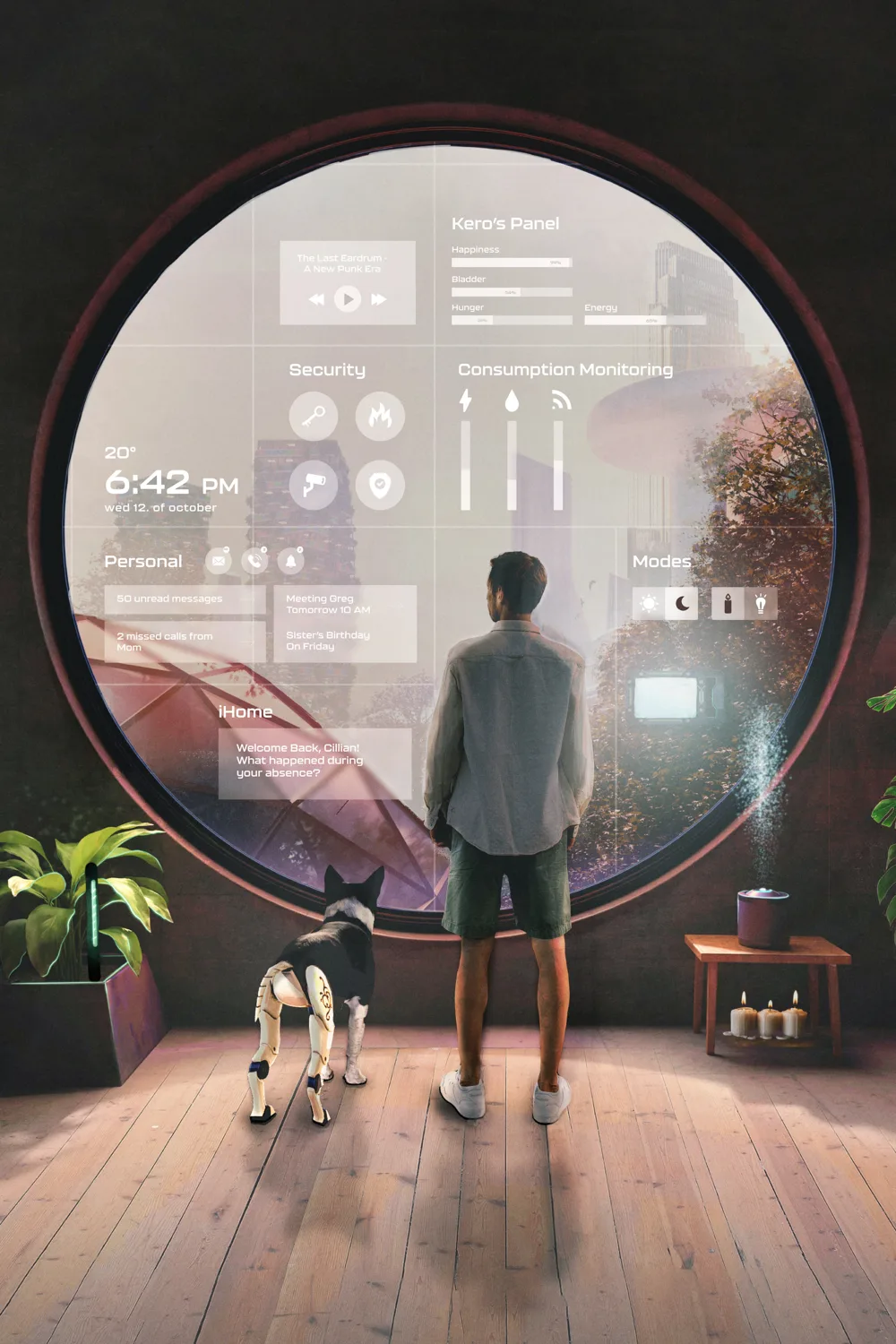
11th floor, Cillian’s apartment door opens automatically, recognising its owner. Inside the large living room, Kero, Cillian’s dog waits patiently for his owner. The sweet voice of Eirebot is welcoming him back. Cillian likes to think of Eirebot as his virtual butler. He baptised it after his love for his native country. Eirebot can control more or less everything in its little 100-square metre realm and is connected to a control panel from where Cillian can check multiple data such as his latest messages, news from the flat, temperature and much more.
The apartment is as clean as a whistle despite the two-week absence of its owner and there is a nice sandalwood scent throughout – Cillian’s favourite. Just before his departure, Cillian had programmed Eirebot to launch the BACKHOME programme which triggered, among other things, the vacuum-bot, and the essential oil dispenser, one hour before his return. The bot also took good care of Kero. The dog’s general mood seems really good, according to the control panel display. The bot was programmed to deliver exactly 90 grams of dog-food, three times a day at fixed times. It has also been letting Cillian’s sister Annie enter the apartment every evening to take Kero to the park. Speaking of Annie, it’s her birthday in a week! Cillian is lucky the information popped up on his control panel. Just a few more days to find a nice gift.
As the owner of the top floor apartment, Cillian is lucky to have access to a nice rooftop terrace. He climbs the stairs to enjoy the last rays of sun. The terrace floor is made of white concrete with artificial crystal particles. With the sunset, it gives a mesmerisingly shiny spectacle that he’s not used to seeing in the Irish weather. An ideal ambiance for a glass of Chardonnay. But then his phone rings. It’s Greg, his best friend and co-founder of the company. Greg would like to meet with him tomorrow at 10am to visit the R&D lab where they are developing their new, lab-grown vegan meat substitutes.
Night falls and so does the temperature. It’s still Ireland after all! Cillian heads back inside. The whole apartment automatically switches to EVENING mode. The lights in the living room have become softer and the stove hood lights are now shining brightly. Time to prepare something for dinner. There’s almost nothing left in the freezer, but his smart fridge tab indicates to him what he can make from what’s left inside. As the tab is connected to the control hub, it also suggests a grocery list, based on what Cillian usually likes to buy, which he can send directly to his favourite supermarket for delivery. Tonight will be chili sin carne. As the cooking smoke comes out of the pan, the kitchen hood automatically extracts at exactly at the right strength. The connected pan lights up green when Cillian’s dish is ready. Time to eat!
As soon as Cillian sits down at the table, Eirebot starts the 4D TV. But the young businessman isn’t paying attention and puts his quantum laptop on. Finally, after two weeks without any proper online protection, he’s happy to be back to the online security his home provides. Speaking of security, he learns via the notifications from the AI syndic on his control panel that someone, clearly with no good intentions, had recently tried to break into the flat. Luckily, the flat was prepared for this, thanks to its own bot, which automatically called the police. How silly these thieves can be. It has become impossible to break into homes with all the technology deployed to protect it.
After a few hours on the computer, Cillian heads to the bedroom. All the lights from the other rooms are progressively switched off while the bedroom is bathed with a low wavelength lighting, boosting Cillian’s melatonin production. The temperature is ideal for good, restorative sleep, not too cold and not too hot. Eirebot has automatically set an alarm clock according to the time he will need to get ready, and taking traffic predictions into account, to make sure he’s on time for tomorrow’s meeting with Greg. Cillian jumps into bed. The light slowly decreases as Eirebot plays four to seven Hertz soundwave music for relaxation. Everything is set to have him fresh and ready for tomorrow.
// The science behind it
Your house at your service
In 2051, building – especially for residential purposes – isn’t what it was thirty years ago. The context is different, the climate has changed – a new paradigm now exists. With rising sea levels, flooding has become more and more recurrent, especially for maritime states, and temperatures have become even more out of whack. The need to investigate new ways of building accommodation that can withstand these new, and extreme conditions, has become more urgent than ever before.
To address the extreme temperatures, steps were taken towards cooling down cities. Up to 84% of cities with more than 100 000 inhabitants – and 100% of the biggest megacities – made it compulsory to use the most reflective possible materials and coatings on houses and buildings, thereby reducing the effects of the sun’s rays. Manufacturers and DIY shops started to offer new solutions in this matter, including ultra-reflective paint, and concrete embedded with artificial crystal. Over a period of ten years, this solution allowed citizens of the world to reduce their cooling bill by 20%.
After multiple, devastating floods, many coastal and river cities worked towards a solution to stem the rising tide. In this regard, plant walls proved to be really efficient in absorbing excess water during heavy rains and controlling floods. So much so, that they were imposed on at least two walls of each new building, whether it be houses, flats or businesses – built after 2043. And while the floods became more and more persistent until 2040, these disasters started to recede as more and more buildings installed plant walls. In addition, these walls allowed considerable energy savings by acting as natural barriers in keeping the cold inside during summer and the heat inside during winter. The gardening and manutention of living walls became easier thanks to automatic watering using rainwater tank supplies as almost every building has had one since 2030.
By 2051, these interventions – reflective paint or concrete and plant walls – have become a sine-qua-non condition to help us better control climate change. But the bigger revolution takes place at the heart of everyone’s homes.
Watch what you say, your house is alive!
2021 already saw the advent of Google Home, Amazon Alexa, Apple HomeKit and other hubs to help manage your house or apartment. But these were quite intimidatingly complex if you were a newby. For example, you had to make sure that any every device in the house had to be compliant with your home assistant, and there could be a danger of being tricked into buying brand new lightbulbs with sensors, that weren’t compatible with the system you had for the house. These connected devices were either working on Bluetooth or WiFi. In the case of the former, as soon as you lost signal you might encounter working problems with your devices. And while Wifi was a bit more reliable, it required more energy for optimal working.
That’s when Matter (standard) and Thread wireless mesh protocol arrived as a saviour at the beginning of the 2020s. And by 2051, it’s impossible to live without it. Since 2031, every home has had its own Matter ID. When buying a new place to live, or when building your new house, integrating a complete smart home system has become mandatory. Each house ID is associated with a specific layout on the Matter Hub and all the parameters are already set as the default. It’s then up to the owner to parameter everything and to use shortcuts for specific actions.
Indeed, like green walls and high albedo materials, smart homes have become more and more efficient as Matter and its Thread communication system have improved. Automatically switching the heaters off and sensors on lights were already a thing in the 2020s, but now your smart home also is your personal energy assistant. Whether it’s lowering the heater when it doesn’t sense your presence in the room, or automatically adapting the temperature given the amount of sunlight, everything is designed to minimise your energy bill and footprint.
Your house is also becoming a presence on its own. If you programme it that way, it will be able to welcome you with a warm fire in the stove – or just with the heaters on – and with your preferred lighting you like. It can even play your favourite playlist or station as you open the door. Your home takes care of you by setting the right ambiance at the right time, relaxing in the evening for a good night of sleep, energising in the morning with some positive music and a concentrated mango scent. It even goes further. Some modest income families even programme their house to automatically go to ECONOMY mode – with very little heating and low lightning – when their bank accounts are below a certain amount.
The smart homes of 2051 are also playing a huge role in security, both online and offline. Each house now provides a very strong firewall to any connected device in the house, including computers, smart TVs, cameras and phones but also connected light bulbs, fridge, oven and so on. Each house has its own AI, included in Matter’s hub – capable of detecting any breach or any attempted intrusion. And it’s the same in the offline world. As almost every dwelling is fitted with face-detecting cameras, the police are instantly notified when someone is trying to break in. The house is also capable of detecting all risks pertaining to electricity, gas, or fire. These security features have even become compulsory in many cities in the world.
But the Matter hub offering has also extended to include offices, government buildings, museums, warehouses and so on. It’s become indispensable for practically every building on earth. From 2045, it was the responsibility of each company and government to equip their buildings with smart home devices. Financially and environmentally speaking, it was in the interest of all to drastically improve energy management in offices.
As demand for Matter hubs was increasing for offices, the Connectivity Standard Alliance launched its brand-new hub solution for companies. The BMatter solution was tailor-made for each company. Printers on 24/7, heaters next to open windows, lights on in empty rooms, all these are now just bad memories from the end of the 2020s. Just like smart homes, smart offices are managing everything seamlessly. Companies even have energy reduction targets to respect every year and must publicly share their annual energy consumption reports. Poor performers are penalised with a fine proportional to their energy waste. 2050 was the first year where no fine was recorded around the world. And companies managed to reduce their energy bills by 43%.
BMatter of course, also provides premium security tools. So much so that data leaks have become very rare. BMatter can protect each employee’s devices and thwart hacking attempts efficiently. The Thread radio standard allows for a very rapid response from any connected device registered in the hub – even over long distances – thanks to Mesh networking.
A new beginning for smart homes
We are in 2021 and heaters switching off when they detect an open window aren’t anything new. There are even apps that allow you to control them remotely and programme them as you wish. Apple or Google Home applications offer the same thing, but on a larger scale. It is already possible to programme your whole home to have specific lighting or heating parameters according to the time of the day or season. But the fact is that nowadays, the smart home ecosystem and devices gravitating around it, are complex. And this complexity prevents many people from adopting these new technologies.
Already there are different ecosystems – Apple, Google, Amazon – that aren’t compatible. You have some objects connected using Bluetooth, Zigbee, Zwave, and others with WIFI. And on top of this, you have many independent brands that sell items compatible with only part of the ecosystem. A new standard is currently being established with Matter. Yes, Matter already exists! With its hundreds of partnerships, Matter is starting from the best, open-source smart home model, Apple HomeKit. It uses the Thread radio standard and Mesh networking for a better and wider communication between the connected objects.
The Matter standard is at an early stage, but it will allow a more open access to smart home appliances regardless of your chosen ecosystem and brand. And it will go even further. With this global standard set, smart homes will be able to operate as a network and to “communicate” amongst themselves. Let’s imagine that a house at one end of a city detects a change in the weather and that rain is going to fall. Thanks to a waterfall reaction, the house on the other end of the city will be able to get ready for the bad weather and close the windows and the sunscreen without involving its owner.
We can also expect homes to become increasingly smart and instead of executing a simple order, they will be able to act completely independently thanks to the data collected from the outside world. There’s sun hitting the windows, let’s lower the heater and switch the lights off. So the house can detect that its owner is on his way back home thanks to signal from his phone? Let’s heat the room, switch the lights on and start his favourite music. Everything will need a parameterisation but after that the home will act just like a living entity at the service of his owner: a real digital butler.
This new standard will also pave the way for bigger entities such as businesses, government offices and public buildings such as train stations or airports to use these smart connected devices. Matter will surely help them manage their energy consumption better in a very wide area thanks to the Thread radio standard. We can also imagine that a tailor-made offer will emerge for these new buildings and organisations.
And regarding the materials used to build the houses, the research work of Haider Taha, David Sailor. and Hashem Akbari from the Energy and Environment Division of the Lawrence Berkeley Laboratory of the University of California has already proved that high albedo – highly reflecting – materials can be used for reducing cooling energy use. And as for green walls, researchers Gabriel Pérez, Julia Coma, Ingrid Martorell and Luisa F. Cabeza have showed that Vertical Greenery Systems – plant walls – have proved their efficiency in reducing energy consumption especially in cooling periods.
Combining smart materials and smart home technology will undoubtedly help humanity to manage their energy consumption in a more efficient way, whilst also combatting the climate crisis.
Smart homes as we know them will surely improve with many new features and by being more accessible to all. Privateers and companies alike have a mutual interest in turning to this technology for on-flick energy management and increased security. Online security will probably be a cornerstone of these developments, and it’s not far-fetched to think that houses will also be capable of providing online security. It will be a huge necessity given all the connected devices these homes 2.0 will gather.
Having a living house communicating with others will probably happen but as smart home ecosystems like HomeKit and Google Home are only in their infancies, we might not see it before a few decades.
Sources
Albedo: https://www.osti.gov/servlets/purl/7000986-lpoimS/
Green walls: https://www.fastcompany.com/3016271/this-giant-wall-made-from-plants-isnt-just-pretty-it-can-stop-a-flood
https://www.asla.org/residentialgreenwalls.aspx
https://www.plantsonwalls.com/guides/recirculating-irrigation-living-walls/
https://www.sciencedirect.com/science/article/pii/S1364032114005073
https://www.sciencedirect.com/topics/engineering/energy-saving-in-building
https://www.healthline.com/health/best-color-light-for-sleep#best-colors-for-sleep
Smart house/office management :
https://www.fmj.co.uk/office-buildings-are-losing-60m-in-wasted-energy-every-year/
https://www.threadgroup.org/What-is-Thread/Thread-Benefits
https://en.wikipedia.org/wiki/Mesh_networking
https://www.apple.com/shop/accessories/all/homekit
https://support.google.com/chromecast/answer/7071794?hl=en&co=GENIE.Platform%3DAndroid
// Sources & further reading
- https://developer.apple.com/design/human-interface-guidelines/homekit/overview/terminology-and-layout/developer.apple.com
- https://madame.lefigaro.fr/bien-etre/nous-avons-testele-reveil-olfactif-101214-93348#:%7E:text=l’odorat.,envelopper%20et%20r%C3%A9veiller%20madame.lefigaro.fr
- https://csa-iot.org/csa-iot.org
- https://www.fastcompany.com/3016271/this-giant-wall-made-from-plants-isnt-just-pretty-it-can-stop-a-floodfastcompany.com
- https://www.apple.com/shop/accessories/all/homekitapple.com
- https://www.asla.org/residentialgreenwalls.aspxasla.org
- https://buildwithmatter.com/buildwithmatter.com
- https://www.sciencedirect.com/science/article/pii/S1364032114005073sciencedirect.com
- https://www.osti.gov/biblio/7000986-lpoimS/osti.gov
- https://www.threadgroup.org/What-is-Thread/Thread-Benefitsthreadgroup.org
- https://en.wikipedia.org/wiki/Mesh_networkingen.wikipedia.org
- https://www.healthline.com/health/best-color-light-for-sleep#best-colors-for-sleephealthline.com