24Oceans· Vision Team
Beyond the blue
// A story from 2051
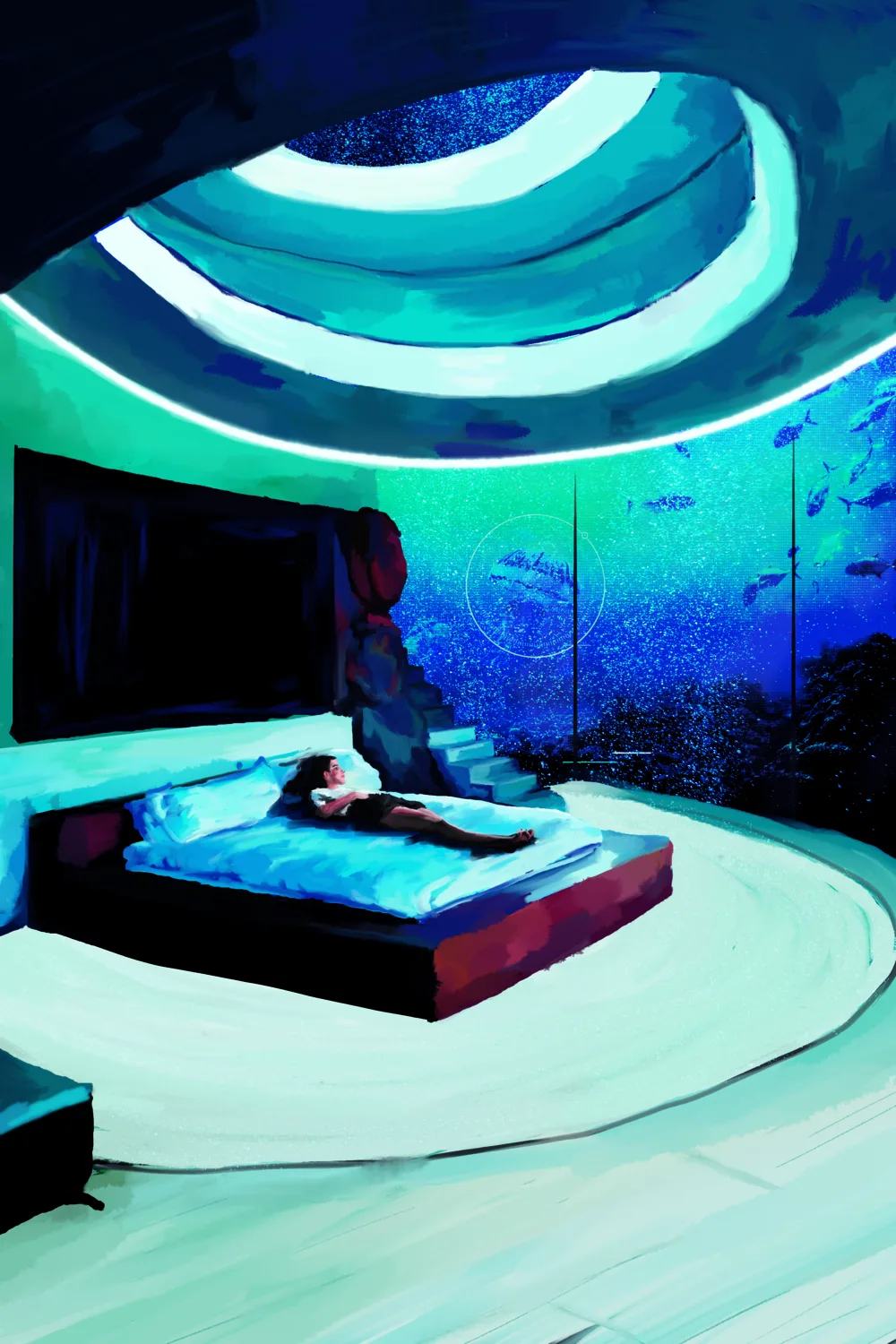
Marcelle wakes up feeling peckish. Not that she has any reason to be ravenous, with her bespoke nutritional supplements. It’s just that today is a special day and she’s going to eat actual food to celebrate the arrival of her twin sister, Mignonne, to the Basin. She checks the time – 5 am. Outside her small pod window, it’s the usual, hazy view of the ocean floor, twenty metres below the surface. Every so often, a flash of light illuminates a tangle of structures in front of her window. Mussel socks and scallop lanterns float behind a sphere in the distance. It’s attached to a greenhouse dome growing watermelons in saltwater. The light source: a swarm of tiny firefly squid, gene-edited to glow brighter if toxins in the water are detected.
These are just some of the sea creatures lured closer to the colony to help illuminate the exterior with their natural bioluminescence. It reminds Marcelle of her dinner menu. She needs to get ready in time for her first appointment – stopping by her friend, who has found some special goodies for her. After months of smoothies and kelp salads, she is really looking forward to the cultured meat schnitzels her friend has sourced, which she’ll serve with a side of sea asparagus French fries, curried kelp and dehydrated corn pops. They’ll wash it all down with a ‘headache light’ Sauvignon Blanc.
She hasn’t seen her sister in over two years, since Marcelle and her partner Luc won a lottery to move to the island section of Neptopia. Situated 50 miles off the coast of Darwin, Australia, Neptopia has slowly come together since the 2040s as a place where like-minded seasplorers congregate to live a libertarian life. The enormous ocean farm has been in existence since the 2030s, but it was only when a famous Bitcoin billionaire decided to build a complete underwater city that things started to come together.
Neptopia means different things to different people. For Marcelle and Luc, it’s a way to live a more meaningful life and see if they can tolerate being underwater for that long. There is a rumour of another Neptopia colony spawning off the coast of the Soloman Islands, where one can buy a ‘sea smallholding’ and cultivate a specific new type of microalgae used in deep ocean farming. In return for a harvest, residents are paid in the cryptocurrency Seacoin, and are allocated special visas to live on any of the five micronations around the world.
There are only a handful of hairdressers in the ocean colony and Marcelle won some extra points for being an English tutor, hairstylist and a pet groomer to the wealthy Neptopians who were allowed to take small pooches with them. After 14 months spent working on the island, the couple heard of someone who had passed away in the Basin. It was finally time for them to move down into the underwater nucleus for their six-month ‘seabattical’. Luc works in transport – ferrying passengers on highspeed hovercrafts from the mainland to the island, delivering algae harvests to visiting ferries, and supervising a fleet of autonomous, water purifying pods. Thank goodness for his great connections because he was able to pull some strings to get Mignonne below (ocean) surface in time for the twins’ 40th birthday.
// The science behind it
Seasteading: the permanent life aquatic
“What if we could live underwater?” must be one of the most fun futuristic games to play. With two-thirds of the earth covered in ocean, it’s only natural for futurists to consider a full-time aquatic life. Firstly, think of the design opportunities for building a new, utopian world – especially when it comes to sustainability. What if you could build a city around people, not cars? What if every house, school, shop and factory could be designed to work in synergy with one another, grow food, manage its own waste and generate energy? Imagine upping the anchors and moving your city wherever you want it? Not having to worry about land appropriation, even classism. With affordable housing levelling the playing field, everyone starts from scratch.
But much as one can fantasise about libertarian societies, beautiful coral views, and bathing in ocean water, rising sea levels are hugely concerning. By 2050, 90% of the world’s largest cities will be exposed to rising seas. Currently, around 40% of the global population lives within 100 kilometres of the coast. These coastal cities are growing faster than they can grow infrastructure.
Shanghai, Mumbai and Miami are just some of the 570+ cities expected to be mostly underwater by 2050. Cities that straddle lakes, sit on stilts, float from harbours out to sea, or even exist entirely in the ocean, will be commonplace. We’ll continue to see ingenious ways in which countries will deal with flooding. There will be ‘sponge’ cities like China’s, massive sea walls like Jakarta’s, and living water cities such as New Orleans. Some will pour giant amounts of sand into the water (witness Hong Kong); others will completely relocate their people like the Republic of Kiribati. This independent island nation in the central Pacific Ocean bought climate-refuge land in Fiji to house its Micronesian nation when (not if) it becomes permanently flooded.
Managed retreats, climate refugees and seasteading will be hot topics, as an answer to rising sea levels, over-population, farmland, or renewable energy sources. Seasteading – floating ‘micro-countries’ with ‘start-up governments’ – will give forward thinkers ways to experiment with new ideas that current governments are reluctant to try. These are some of the ideas floated (if you’ll permit the pun) by The Seasteading Institute – founded by anarcho-capitalist Patri Friedman and initially funded by tech billionaire, Peter Thiel. Before Thiel let his dream go, he wrote in a 2009 essay how a new, libertarian society could be built on one of three technologies: cyberspace, outer space or seasteading – "an escape from politics in all its forms". The Institute sees seasteading as a very Silicon Valley way of thinking – that even governments can be ‘hacked’ and that, with nearly half of the world’s surface an unclaimed, blank slate, they can create a platform to try out new nations and new ways of governing.
While some call the Institute’s ideas elitist pies-in-the-sky (even ‘tech colonialism’), the coronavirus pandemic has just fuelled the desire of libertarian groups to build autonomous new societies. Back in 2017, French Polynesia was on board with the idea, signing a historic agreement to develop the first floating city in a lagoon on the island of Tahiti. It ticked all the Silicon Valley boxes: exclusive, just an eight-hour flight from Los Angeles, tax haven, more or less self-governed, fibre to Hawaii, and spectacular surroundings. French Polynesia also has the world’s largest exclusive economic zone (an area of sea stretching 200 nautical miles from a territory’s coastline). In the end, there wasn’t enough in the deal for Polynesians to go through with it. They don’t pay tax anyway, they live in paradise, and they don’t need people spoiling their view.
The Maldives, an archipelago of 25, low-lying coral atolls in the Indian Ocean and the lowest-lying nation in the world, is building the first-ever ‘island city’ ten minutes by boat from the capital Malé. Homes will float on a flexible grid across a 200-hectare, warm-water lagoon. Along with a ring of barrier islands, giant new coral reefs will be grown to act as water breakers. As the former Maldivian president said, when you can’t stop the waves, “you rise with them”. Designed by a world-renowned leader in floating infrastructure, Dutch Docklands, the company is also testing the technology in the Netherlands.
Advance, not retreat
In 2019, the UN-Habitat – a United Nations programme for sustainable urban development – hosted a roundtable of architects, designers, academics and entrepreneurs to discuss the viability of floating cities as a solution to climate change and affordable housing. Hosted together with Oceanix, the MIT Center for Ocean Engineering, and the U.S.-based Explorers Club, this was where the concept idea of Oceanix City was first introduced. Designed by Big Tech darling Bjarke Ingels, this hurricane-resistant, zero-waste city will be made up of 4.5-acre hexagonal, floating islands that each house 300 people. It can be put together in infinite configurations: six islands form a village, and six villages form a small city of 10,800 people across 75 hectares.
This modular city is designed to house a man-made ecosystem with a circular economy. It can withstand severe weather conditions, produce its own power and plant-based food, create drinking water and handle waste disposal. Biorock will be used to make robust, artificial reefs for corals to grow. Food waste will be converted to energy and compost in community gardens, single-use packaging will be eliminated, and sewage will be treated in algae ponds. All vehicles (ferries, scooters, etc) will be electric, of course. Fresh water will be supplied via the latest water vapour distillation technology, atmospheric water generators and rain harvesting systems. Energy will come from wind turbines, algae bioreactors, solar panels and wave energy converters. Food – from sea greens and fish to fruit and vegetables – will be grown in greenhouses, vertical and aquaponic farms and 3D ocean farming (like vertical farming, but underwater).
“Advance instead of retreat” is what drives Oceanix founder Marc Collins Chen, who was the minister of tourism of French Polynesia in the early 2000s. Chen was also involved in the French Polynesian ocean city that didn’t materialise. When sea levels rise, retreat will be possible for places like Miami or Bangladesh. Some might go for a hybrid land cum floating city. Others, like Indonesia, are already making provisions for this flooding. Before the pandemic struck, Indonesia had firm plans to move its capital city of Jakarta to the island of Borneo. Speaking from experience, Chen is an advocate of pushing cities beyond the edge of the water. Managed retreats will definitely become part – or wholly – floating neighbourhoods, where roads become canals.
Oceanix is happening – already funded by a (secret) private venture capital firm and with the French company Bouygues Construction on board. Where it will be remains to be seen, or if it can be the solution to a global population that is fast running out of space. As the climate crisis worsens, more than one billion people will live in countries with insufficient infrastructure to withstand sea-level rise by 2050, according to The Institute for Economics and Peace. At this rate, it would take over 9,000 Oceanix cities to rehome these projected climate refugees.
If you’re worried about how such a vast, floating structure will cope in high seas with storms and 80-foot waves, experts in naval architecture and marine engineering are already on top of it. MARIN (Maritime Research Institute Netherlands) has tested an innovative concept for a floating mega island that could provide a living and working space at sea for developing, generating, storing, and maintaining renewable energy, including offshore wind. These modular, three-sided islands can work for any size and, eventually, in any kind of weather.
MARIN has already tested this structure in its test pool (one of the largest indoor pools in the world), pummelling it with the equivalent of 82-foot waves. With a flexible, wave-facing part of the island cushioning the blows, no crests crashed over it. Whatever is used in future, whether it’s hinged triangles, spars or pontoons, it won’t be long until a failsafe solution is on the table.
The ultimate ocean views
Practicalities aside, let’s dive into the fun part: what these floating buildings and rooms could look like. If you want to own a piece of that fish tank feeling, you’ve missed the boat with Dubai’s stunning Floating Seahorse Villas. All 133 of these have sold but you can probably rent one to experience the brilliance of floor-to-ceiling glass as you admire marine life and colourful coral reefs from your bedroom. Even at night, you can watch the reefs come alive with nocturnal marine activity. Each villa has two storeys with four en-suite bedrooms, indoor and outdoor living areas, a roof with an infinity swimming pool and a glass floor so you can see views of the water below. There will also be a kitchen, living room and two staff quarters.
Water Discus Hotels, the prototype by Polish company Deep Ocean Technology, feature a modular design comprised of two discs – an underwater and above-water one – that resemble saucers. Each hotel will be situated ten metres underwater to make the most of sunlight, and will contain twenty-odd rooms, a bar and a restaurant with views of surrounding coral reefs. There has been talk of construction in Dubai, Singapore and the Maldives, but nothing has materialised yet.
Poseidon Undersea Resort is another yet-to-be-built underwater hotel that will have submarine-style capsules and even an underwater wedding chapel forty feet underwater. Spread across two hectares, nearly 70% of the suites’ surface areas will be transparent, providing spectacular views of the undersea world.
Other underwater rooms exist at the InterContinental Shimao Wonderland in Shanghai, Reefsuites on Australia’s Great Barrier Reef, Hilton's Conrad Rangali Island Resort in the Maldives, and the Underwater Suites at Atlantis, The Palm in Dubai. If luxury resort living is not your thing (or in your budget), perhaps the privacy of an Anthenea pod is more your cup of kelp. These eco-friendly mobile homes are completely off the grid, with a futuristic design inspired by the James Bond film, The Spy Who Loved Me. Guests can enjoy panoramic, 360-degree views from their round beds or peek at sea life through glass panes. The best part? These pods can be sailed around the world, while black and greywater are treated on-board, releasing clean water back into the ocean.
On an even more modest, yet perfectly achievable scale, is the Makoko Floating System (MFS) by NLÉ – a very simple way to build on the water by hand. It is a prefabricated, modular, floating A-frame structure made from sustainable timber. It can be locally produced, assembled and disassembled – and quickly too. Designed by Nigerian architect Kunlé Adeyemi, it has evolved from a floating school to being deployed in five countries across three continents. Adeyemi created this design in an effort to reimagine life in Makoko – the floating slum in Lagos that is sometimes called the ‘Venice of Africa’. It’s inhabited by around 250 000 people who not only live on water but also depend on it for their livelihood. It will be interesting to see how this prototype evolves and if it meets Adeyemi’s vision of African Water Cities.
Perhaps, instead of building new water cities, we’ll find a way to inhabit the plastic islands that already exist? In 2021, a new study found that the Great Pacific Garbage Patch floating in the Pacific Ocean between California and Hawaii is 16 times bigger than was previously thought. It’s said to be made up of enough fishing nets, plastic containers, ropes and microplastic to fill 500 jumbo jets. The Ocean Cleanup is making good headway in catching this environmental disaster, with its fleet of long, floating barriers that act as an artificial coastline. Using winds, waves and currents to passively catch and concentrate the plastic, it slowly drifts along the 1.6 million square kilometres of this trash vortex – three times the size of France.
But what if these islands can be turned into liveable islands? That’s exactly what architect Margot Krasojević is proposing. Her concept for a luxurious, 75-room hotel will use large, plastic-filled bags woven together as an anchor to the ocean floor. These bags will be weighed down with silt and sand to make the structure stable. There will be artificial, mangrove-like ‘roots’ to trap sediment and act as a flood defence by sucking up water to inflate when needed – almost like a lifejacket. With funding already in place, this could be a new form of eco-tourism where, as you sip your pina coladas on the pool deck, your floating hotel filters and saves the ocean.
Architect Ramon Knoester’s Recycled Island also plans to use plastic from ‘trash island’ to create a completely self-sufficient island the size of Hawaii. It will support its own agriculture and derive its power from solar and wave energy. When completed, it could house 500 000 residents. Keen to see it happen? The project is still floating around on Kickstarter, so it’s ripe for the taking.
Living like the aquanauts
Staying a few nights in an underwater hotel or zipping around in a pod for a week is one thing but living underwater for extended periods of time needs to consider every possibility, from security and bad weather to food and water. So is it really possible? Absolutely, according to Ian Koblick. As a pioneer of ocean exploration since the 1960s, he was one of the first aquanauts – those who not only work underwater but live underwater too.
Ian designed and operated La Chalupa in the 1970s – the most advanced undersea lab in the world in Key Largo, Florida. In 1986, it was converted into Jules’ Undersea Lodge, at the time the world’s only undersea hotel, and operating an environmental education centre. It was at this lodge that two scientists broke the record for the longest time spent living in an underwater, fixed habitat. They spent 73 days, 2 hours and 34 minutes living 7.31 m (24 ft) underwater. As someone who has often spent two to three weeks underwater, Koblick thinks longer periods for larger groups are completely possible. Neither he nor his colleagues ever experienced any ill-effects from living below the surface, so he thinks up to six months would be feasible. According to a 2013 interview, he doesn’t see any technological hurdles to making this happen – it’s only a matter of money. Okay, and things like emergency evacuation systems, controlling air supply and humidity, not to mention human adaptation to extreme environments (read: psychological effects).
This is something closely monitored at “the world’s gateway to inner space” – the Aquarius Reef Base in Florida and the training ground of NEEMO – NASA’s Extreme Environment Mission Operations. Groups of astronauts, engineers and scientists are sent to the world’s only operational and habitable undersea saturated environment to prepare for space exploration. Space hopefuls fulfil a series of simulation missions, like practicing space walking. If you’re wondering what ‘saturated’ means, it’s what happens after spending twenty-four hours underwater at any depth, when the human body becomes saturated with dissolved gas. In essence, this means that aquanauts can remain underwater for an indefinite amount of time.
Creating underwater habitats has been a lifelong dream of Koblick and is also the focus of Open Sailing – an international community of architects, engineers, inventors and scientists working on Open Sailing technologies to explore and study the oceans. The project began as an apocalyptic design response unit but has evolved into a collective that wants to build an International Ocean Station (like the International Space Station but for ocean living). Some of these technologies included Nomadic Ecosystem (mobile aquaculture to sustain long-term life at sea), Life Cable (unified standard for energy, water and waste), the Open Politics think tank on how to organise a new oceanic urban structure, and Openet.org – a purely civilian Internet moderated only by its users. The idea of Instinctive Architecture meant that the whole structure would behave like a super-organism, reconfiguring itself according to weather conditions. For example, in stormy weather it could shrink to protect itself from waves and wind, and in calm seas it would expand in different directions to have more space for fish or seaweed farming.
Someone who is making this dream come true is Jacques Cousteau’s grandson Fabien, who is going to build a space station of the sea named after the prophetic sea god, Proteus. The station will be located at a depth of 60 feet, in a biodiverse, Marine Protected Area off the coast of Curacao. It will be ten times the size of the Aquarius Reef Base, and will contain living quarters, research laboratories, medical bays and bathrooms. Proteus will also include an underwater greenhouse so that inhabitants can grow fresh plant life for food.
One of the main aims of Proteus is to increase our knowledge of the ocean seafloor through high-resolution, 3D mapping. About 80% of the ocean hasn’t been explored yet, so this will be a critical tool for protecting and tracking marine life, regulating underwater exploration, assisting with rescue missions and predicting natural disasters like tsunamis. The better we can map the oceans, the better we’ll understand ocean circulation, weather systems, sea-level rise, and climate change. Eventually, the hope is for a whole network of Proteus bases, situated throughout the ocean.
Deep ocean mariculture and ocean crops
If we were to live on or underwater for long periods of time, food cultivation is obviously high on the agenda. Global fish demand is set to double by 2050, with experts predicting that aquaculture (farmed fish) will be responsible for up to 90% of this supply. While farming fish on land is well-established, and growing filter feeders like mussels and oysters are very doable, it’s the carnivore fish like tuna that are more challenging to farm. Farms will increasingly look at fishmeal alternatives like insect, algae and plant-based aquafeeds. If we’re going to feed nine or ten billion people in 2050, we can’t do that by grinding sardines and anchovies forever. With some of the highest concentrations of EPA and DHA polyunsaturated fatty acids of any fish species, these fish should be our food, not fish food.
Looking at mariculture innovations, this could actually drive ocean living faster than we think. There is a ‘blue rush’ going on right now to exploit the vast, unclaimed ocean resources. Whereas marine fish farming usually happens close to the coast in sheltered bays, there is a move towards farming fish much deeper in the ocean. Take, for example, Open Blue, which runs the largest open-ocean fish farm in the world. Located 11km off the coast of Panama, this cobia farm has 22 pens that can produce 1,200 tons of fish annually with no effect on the environment.
SalMar’s Smart Fish Farm will be significantly larger than its Ocean Farm 1, with a production capacity of 23,000 tons round weight. This super-cage will exist in an area of open sea between 30 and 70 miles off the Norwegian coast. It’s the first time someone has applied for approval of a site for aquaculture in the open sea (with the Norwegian Directorate of Fisheries). It will also take salmon fishing deeper into the ocean than ever before., with a vast structure that’s able to withstand a 100-year storm.
Going even deeper: Ocean Era’s floating aquapods have trialled ‘over-the-horizon’ fishing of kampachi, off the coast of Hawaii. Two thousand of these sashimi-grade fish were put inside the sphere and attached to a remotely controlled, unmanned feed barge which would then drift up to 75 miles off the coast. Technicians ran the farm remotely, from a smartphone or tablet, only visiting the site once a week to top up the feed or fuel the generator. The company will also trial a submersible growing platform for microalgae, moored approximately 120 metres below the ocean. This means there will be no impact on water quality, coral reefs, or dolphin resting activity.
When we look to the future of ocean food, the word that always crops up is seaweed. Or, as its advocates like to call it, sea greens. With over 10 000 edible plants in the ocean, expect to see these green superfoods incorporated into our daily meals just like rocket, spinach and kale. Sweet sea moss smoothies, kelp carrot cake, pickled kelp, sugared kelp, seaweed mash...your culinary lexicon will get to know words like wakame, dulse, arame and hijiki. These restorative crops are cheap to grow and could help us in the fight against climate change and ocean pollution.
Making regenerative ocean farming accessible to all is Bren Smith’s pioneering, 3D vertical farming method. Through his company Greenwave, he is sharing his revolutionary, open source polyculture farming system with the world. It can grow a mix of seaweeds and shellfish with zero inputs – making it the most sustainable form of food production on the planet. It also sequesters carbon and rebuilds reef ecosystems. All you need is a boat, about 20 acres of ocean and $20-50K in start-up cash.
Seaweed, mussels, clams, oysters and scallops all grow together happily in this vertical tunnel – even in waters that are dying from acidification. Now consider the vast job creation potential seaweed farming could have and it’s easy to imagine future entrepreneurs living permanent ocean lives. According to a World Bank study, farming seaweeds in just 0.1% of the world’s oceans (about 100 million acres) could create 50 million jobs.
Fish aside, what about growing fresh produce in the ocean? Ocean crops offer an exciting new frontier for agriculture. Companies like Agrisea are testing how rice can grow in saline conditions and is confident that large floating crop islands will be a common sight in thirty years’ time. Researchers from Nottingham University have come up with Floating Ocean Farms – floating containers where crops can be grown using hydroponics or aeroponics. Containers would be lit by LEDs to maximise photosynthesis, while power would come from offshore wind turbines, wave or tidal power.
Off the coast of Italy, the Nemo’s Garden Project by Italian ocean diving company, Ocean Reef Group, has been growing strawberries, orchids, basil and lettuce in pods on the ocean floor since 2012. They’ve recently teamed up with Siemens to further study and improve this technology to finalise its industrialisation as a sustainable food alternative. If we can be even more adventurous, we could be eating salt-loving sea vegetables like sea asparagus, saltwort and sea purslane. Rich in nutrients, these veggies grow in as little as eight to ten weeks.
Energy on the ocean
The final piece of the ocean living puzzle: how would these underwater cities, farms and factories be powered? Naturally, solar power is the first logical idea. After all, the sun shines just as much on the water as it does on land; plus, the seawater can help cool the solar panel technology. One could take inspiration from the world’s largest floating solar farm on Indonesia’s island of Batam. Built on an area of 1,600 hectares, it will have an expected output of 2.2 GW. It will also have the largest energy storage system with a capacity of over 4000 MW. Or we could look at Norway’s SINTEC who will also test a solar farm at sea. In an effort to cope with stormy seas, researchers have tested an anchoring system that will give the installations enough freedom to cope with large waves.
But perhaps we need to think much bigger than wave, sun and wind energy. How will we power farms deep under the ocean where it’s dark? Plankton power could be the answer – especially to power oceanographic sensors that constantly need replacing. The US Naval Research Laboratory created OSCAR (Ocean Sediment Carbon Aerobic Reactor) that taps into a natural voltage gradient created by a pair of chemical reactions happening on the seabed.
And, who knows, maybe by 2050 scientists will have figured out how to harness the endless energy from underwater volcanoes. Most of the Earth's volcanic activity takes place several kilometres underwater. Scientists have only recently monitored how far these underwater explosions (known as macroplumes) stretch, but measuring the ripple effect showed enough energy to power an entire continent.
What will push us into the ocean for good? The ‘blue rush’ for algae farming? Overheated cities? Power-hungry dictators? Some sort of natural disaster that makes the air unbreathable? Floating farms, ocean colonies and clusters of underwater micronations – it’s only a matter of time before some version of these becomes the eighth continent, with a cool name like Oceania, Neptunia or Zealandia. Perhaps it will be a much larger version of Sealand – the world’s tiniest (unofficial) sovereign entity. The original Sealand has been going since 1967, complete with its own anthem, currency, football team and hyper-secure data fortress.
Who wouldn’t want their own country where you can do whatever you like, whether it’s working a three-day week (or not work at all), enforce veganism or do as Liberland does, simply ‘live and let live’? Perhaps it will be the promise of a simpler life, some peace and quiet, away from the maddening, mind-bending metaverse noise, basking in the ultimate cocoon life of perpetual daytime and magical, luminescent fireworks. As soon as it’s possible, sign us up. To quote Jules Verne: “The sea is everything.”
// Sources & further reading
- https://www.asme.org/topics-resources/content/can-engineers-build-floating-cities-to-save-island-nationsasme.org
- https://www.thenationalnews.com/lifestyle/luxury/property-of-the-week-underwater-views-from-dubai-s-dh88-million-floating-seahorse-villas-1.thenationalnews.com
- https://www.wallpaper.com/architecture/kunle-adeyemi-climate-change-architecturewallpaper.com
- https://edition.cnn.com/style/article/plastic-resort-scli-intl/index.htmledition.cnn.com
- https://www.atlantis.com/dubai/atlantis-aquaventure/diving-in-atlantisatlantis.com
- https://big.dk/#projects-sfcbig.dk
- https://www.smithsonianmag.com/innovation/jacques-cousteaus-grandson-wants-to-build-international-space-station-of-the-sea-180975635/smithsonianmag.com
- https://www.smithsonianmag.com/innovation/in-face-rising-seas-are-floating-cities-real-possibility-180978409/smithsonianmag.com
- https://www.marineinsight.com/future-shipping/concept-water-discus-underwater-hotel/#:%7E:text=The%20water%20discus%20hotel%20is,to%20an%20amarineinsight.com
- https://www.advancedsciencenews.com/underwater-volcanoes-unleash-enough-energy-to-power-a-continent/advancedsciencenews.com
- https://www.forbes.com/sites/nishandegnarain/2020/07/29/ocean-crops-is-this-the-next-frontier-for-agriculture/?sh=32a88b4b5c95forbes.com
- https://www.glowee.com/glowee.com
- https://www.theguardian.com/world/2021/feb/24/kiribati-and-china-to-develop-former-climate-refuge-land-in-fijitheguardian.com
- https://www.theengineer.co.uk/floating-deep-farms-food-production/theengineer.co.uk
- https://edition.cnn.com/2019/12/11/world/swim-great-pacific-garbage-patch-c2e-intl-hnk/index.htmledition.cnn.com
- https://sensing.konicaminolta.us/us/blog/living-light-is-there-a-future-for-bioluminescence-technology/sensing.konicaminolta.us
- http://www.nleworks.com/case/makoko-floating-system/nleworks.com
- https://oceanixcity.com/media/oceanixcity.com
- https://www.newscientist.com/article/dn1375-plankton-power-produces-indefinite-electricity/#ixzz79dYdAZYvnewscientist.com
- https://www.bbc.com/future/article/20130930-can-we-build-underwater-citiesbbc.com
- https://www.space.com/33608-50-astronaut-aquanauts.htmlspace.com
- https://www.designbuild-network.com/projects/poseidon-undersea-resort-fiji/designbuild-network.com
- https://www.businessinsider.com/libertarian-peter-thiel-utopia-seasteading-institute-2018-3?IR=T#he-imagined-an-escape-from-politics-in-all-businessinsider.com
- https://www.theguardian.com/environment/2020/jun/24/seasteading-a-vanity-project-for-the-rich-or-the-future-of-humanitytheguardian.com
- http://waterdiscus.com/pl/waterdiscus/waterdiscus.com
- https://www.ecowatch.com/maldives-floating-city-2653145087.html#toggle-gdprecowatch.com
- https://www.nourishlife.org/2016/12/3d-ocean-farming/nourishlife.org